
The Dollar Milkshake Theory


The Dollar Milkshake Theory
The Dollar Milkshake Theory, articulated by Brent Johnson of Santiago Capital, examines the U.S. dollar’s fortification against a backdrop of worldwide economic shifts. It contrasts the global trend of loose monetary policies with the U.S. Federal Reserve’s more stringent stance. This contrast fuels the U.S. dollar’s appeal, potentially boosting its supremacy while also harboring risks of a drastic downfall and ensuing economic turbulence.
Johnson’s theory advocates for a strategic reallocation towards assets like gold and cryptocurrencies, which possess more favorable supply and demand characteristics, to bolster economic stability. This strategic pivot highlights the critical nature of informed and tactical investment decisions in an ever-evolving financial environment.
The Essence of the Dollar Milkshake Theory
At its core, the Dollar Milkshake Theory suggests that the U.S. dollar will strengthen amidst global economic volatility. This notion is driven by the disparity in monetary strategies—expansive actions by worldwide central banks versus the U.S. Federal Reserve’s restrictive policies. As a result, the U.S. becomes a magnet for global liquidity (the “milkshake”), attracting it due to higher interest rates and perceived financial system stability. Despite potential domestic economic hurdles, Johnson believes the U.S. dollar will become a predominant refuge for global capital.
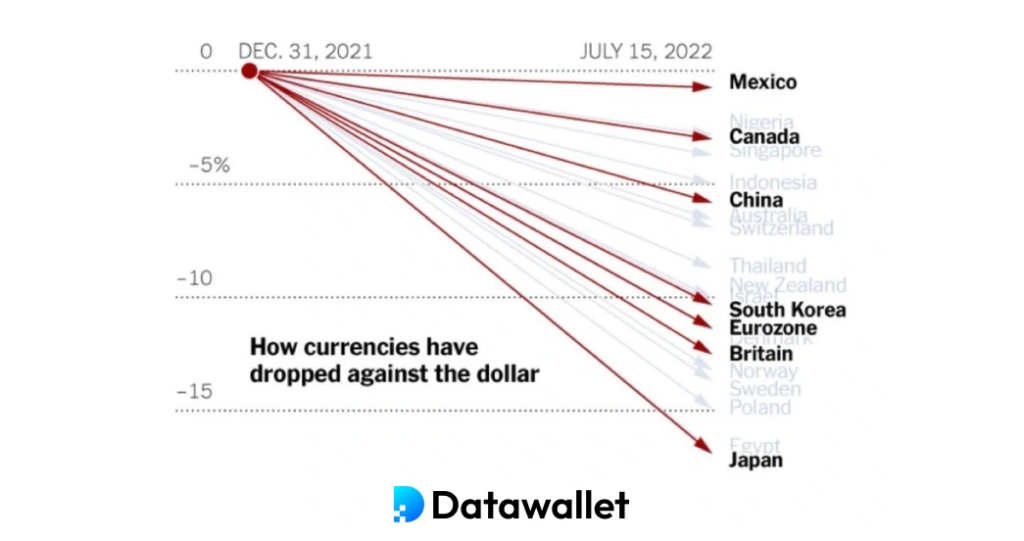
This theory has ignited extensive debates and analyses, underscoring its significant implications on global financial stability and currency dynamics.
Dollar Milkshake Theory’s Climax
The theory’s climax might signal a pivotal shift in the global economic framework, where the U.S. dollar’s dominance, after absorbing vast global liquidity, faces a critical juncture. Its very strength could lead to a precipitous fall, possibly sparking a sovereign debt crisis with extensive economic ramifications.
To counter these risks, a transition towards a more resilient and stable financial framework will be necessary, possibly favoring tangible assets like gold and Bitcoin as more dependable value reserves. This shift intends to solidify the global economic foundation, fostering a more robust financial ecosystem prepared for potential future adversities.
Impact on Gold
The Dollar Milkshake Theory’s influence on gold prices is dual-faceted. Initially, a potent U.S. dollar might suppress gold prices due to their traditionally inverse correlation. However, gold’s stature as a reliable asset in times of significant economic distress may counteract this effect, potentially even elevating its value. The exact impact on gold will intimately depend on the severity of economic conditions and investor sentiment during such periods.
Influence on Bitcoin
The theory’s effect on Bitcoin is speculative, given the cryptocurrency market’s volatile and emerging status. Two scenarios emerge:
- Dollar Dominance: The impact of the Dollar Milkshake Theory on gold is nuanced. A strong U.S. dollar could initially depress gold prices due to their historically inverse relationship. However, gold’s status as a safe-haven asset will likely buffer this impact, potentially leading to increased demand and a subsequent rise in its price during periods of significant economic turmoil.
- Bitcoin as a Digital Safe Haven: Alternatively, if global instability intensifies, Bitcoin’s narrative as “digital gold” will continue to attract increased investment, boosting its demand and price as its scarcity increases on exchanges. However, a stronger dollar and deflation could diminish Bitcoin’s appeal, leading to decreased demand and lower prices. However, if global economic instability worsens and inflation persists due to currency debasement, Bitcoin will attract more investment and experience price increases.
In summary, the Dollar Milkshake Theory provides a sophisticated analysis of the U.S. dollar’s potential path in the face of global economic variability. Developed by Brent Johnson, the theory delineates the intricate relationship between the broad expansionary monetary policies of global central banks and the U.S. Federal Reserve’s opposing tighter monetary stance.
This conceptual framework not only stimulates extensive discussion among financial scholars and practitioners but also highlights the likelihood of a strategic pivot to more stable and physical assets like gold and Bitcoin as a response to the impending economic challenges. As the financial landscape continues to evolve, the Dollar Milkshake Theory emphasizes the critical need for resilience and adaptability in financial infrastructures and investment approaches, guiding stakeholders through the intricacies of global economic dynamics.
Key Takeaways:
Here are the key takeaways of the Dollar Milkshake Theory:
- The U.S. dollar is expected to strengthen amid global economic volatility due to the contrast between the loose monetary policies of global central banks and the tighter stance of the U.S. Federal Reserve.
- The U.S. will attract global liquidity like a “milkshake” because of its higher interest rates and perceived financial system stability, making the dollar a primary safe haven for global capital.
- The dollar’s eventual strength could lead to a sharp fall, potentially triggering a sovereign debt crisis with significant economic consequences.
- To mitigate these risks, a shift towards a more resilient financial system, possibly favoring tangible assets like gold and Bitcoin as reliable stores of value, may be necessary.
- The theory suggests a two-phase impact on gold prices – initially suppressed by a strong dollar but potentially rising later as a safe haven during economic distress.
- For Bitcoin, the outcome is less certain, with two possible scenarios:
a) A strong dollar and deflation could reduce demand and prices.
b) If global instability intensifies and inflation persists, Bitcoin will likely attract more investment as a “digital gold,” boosting demand and price. - The theory emphasizes the importance of adaptability and resilience in financial systems and investment strategies in navigating the complexities of the global economic landscape.
Responses