
The Archetypical Big Cycle

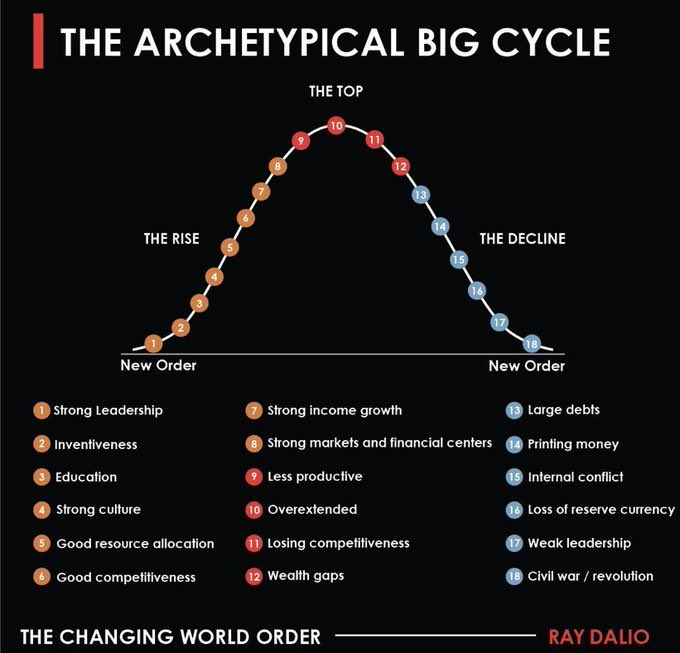
“The Archetypical Big Cycle” illustrates a socio-economic model by Ray Dalio that describes the ascent and decline of a ‘New Order’ within the context of the changing world order. Each point on the curve is numbered, with the ascending part colored in orange and the descending part in blue, suggesting a heat map of sorts where the cycle ‘cools off’ as it progresses towards decline. The cycle is divided into two major phases—”The Rise” and “The Decline”—with eighteen distinct steps that mark the progression from one phase to the other.
Below is a detailed analysis of each number on the curve in the context of socio-economic factors and how they might contribute to the rise and decline of nations:
- Strong Leadership: This refers to the presence of leaders who are capable of setting a clear direction, inspiring the populace, and making effective decisions. Strong leaders can unify a nation and create the conditions for stability and growth.
- Inventiveness: A society that encourages innovation and supports technological advancement can improve productivity and develop new industries. This fuels economic growth and can establish a nation as a global leader in certain sectors.
- Education: Quality education systems develop a skilled workforce that is capable of driving economic growth through increased productivity and innovation.
- Strong Culture: A cohesive culture that promotes shared values can lead to social stability. A strong culture often underpins national identity and pride, fostering a sense of community and cooperation.
- Good Resource Allocation: Efficient allocation of resources, including human, natural, and capital resources, ensures that they are used effectively to maximize economic output and growth.
- Good Competitiveness: A nation’s ability to maintain a competitive edge in international markets is essential for its growth. Competitiveness can be sustained through innovation, quality, and cost-efficiency.
- Strong Income Growth: As a result of the factors listed above, the nation experiences robust income growth, which improves the standard of living and can lead to increased consumer spending, further boosting the economy.
- Strong Markets and Financial Centers: With economic growth, financial markets expand and become more sophisticated, attracting investment and offering more financial products and services.
- Less Productive: Over time, there may be a decline in the productivity gains seen earlier in the cycle. This could be due to a variety of factors, including complacency, lack of innovation, or external competition.
- Overextended: The nation may overextend itself economically, politically, or militarily, leading to excessive debt and strain on its resources.
- Losing Competitiveness: The factors that once made the nation competitive may erode over time, leading to a relative decline in its position on the world stage.
- Wealth Gaps: Economic disparities between different segments of society can grow, leading to social tension and potential unrest.
- Large Debts: The accumulation of debt, both public and private, can become unsustainable, leading to financial crises and the need for austerity measures.
- Printing Money: In an effort to manage large debts, a nation may resort to printing money, which can lead to inflation and the devaluation of the currency.
- Internal Conflict: Social and economic strains can lead to increased political polarization and conflict within the society.
- Loss of Reserve Currency: If a nation’s currency is a global reserve currency, mismanagement of its economy can lead to a loss of confidence and its status as a reserve currency.
- Weak Leadership: The quality of leadership can decline, leading to ineffective governance, poor decision-making, and a lack of vision for the future.
- Civil War / Revolution: The culmination of these negative trends can result in a breakdown of the existing order, potentially leading to civil war or revolution as different groups vie for control or change.
The model provides a conceptual framework for analyzing the rise and fall of nations or empires, correlating socio-economic and political factors with the health and sustainability of a country’s or region’s dominance. This might be used to assess historical patterns, forecast future trends, or even for financial trading and market forecasting purposes.
Responses