
The Ascending Scale of Artificial Intelligence: From Simple Tools to Superhuman Potential

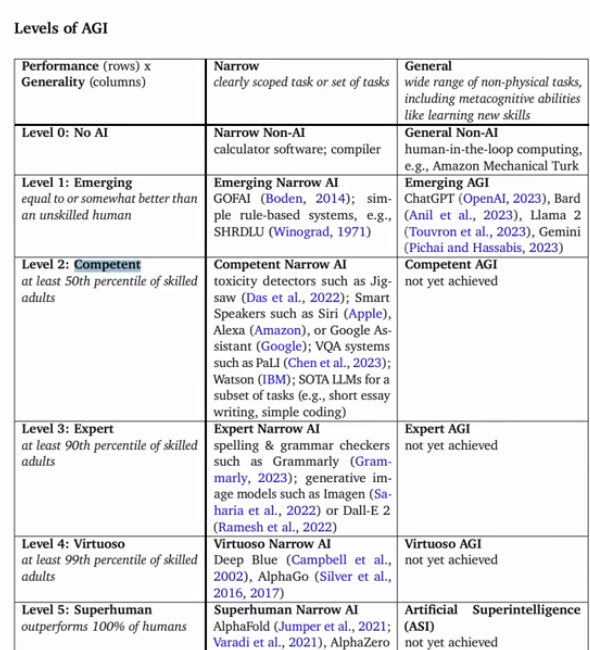
In the rapidly evolving landscape of technology, the concept of Artificial General Intelligence (AGI) represents a pivotal frontier in our quest to create machines that can think, learn, and adapt as humans do. The journey from simple computational tools to the lofty heights of superhuman intelligence is a complex one, marked by incremental advancements and paradigm-shifting breakthroughs. This classification system delineates the various stages of AI development, providing a clear framework to understand the current achievements and the future aspirations of this field. As we chart the progress from rudimentary programs to entities that could one day surpass human intellect, we must also consider the ethical, social, and economic implications of such powerful technologies. The following table offers a comprehensive overview of the levels of AGI, serving as both a roadmap and a mirror, reflecting our own human intelligence through the capabilities we seek to imbue in our digital creations.
Level 0: No AI
- Narrow: This category includes devices or software that do not possess any form of artificial intelligence. They operate based on predefined instructions and lack the ability to learn or adapt. Examples are basic calculators or compiler software, which perform specific tasks as directly commanded by the user.
- General: There is no AI at this level that can perform general or varied tasks; the “No AI” classification applies broadly, indicating the absence of any form of artificial intelligence in the system.
- Timeline: This level is the baseline and represents the pre-AI era. It includes all time before the advent of AI technologies, up until roughly the mid-20th century when the first computers were being developed.
Level 1: Emerging AI
- Narrow AI: These are the early forms of AI that can handle tasks that may require a level of decision-making or problem-solving that is slightly beyond what a simple, non-learning program can do. However, they are still limited to very specific tasks or problems. Examples include early goal-oriented AI systems or simple rule-based systems that can interact with users or process data in a limited context.
- General AI: At this level, we begin to see AI systems that can learn and adapt to new tasks through exposure and experience, similar to an unskilled human learning a new job. Advancing from rule-based systems, machine learning (ML) technologies emerge as a significant leap forward. These systems are trained, rather than explicitly programmed, to perform tasks. They analyze and learn from data to identify patterns, making decisions with minimal human intervention. Applications range from email spam filters to recommendation systems on streaming platforms. A subset of ML, deep learning utilizes artificial neural networks to simulate the way human brains operate, enabling the system to learn from large amounts of data. This approach has led to breakthroughs in computer vision, speech recognition, and natural language processing. Technologies such as voice-activated assistants and autonomous vehicles exemplify this stage.
- Timeline: The inception of this level can be traced back to the latter half of the 20th century with the development of simple rule-based systems and early machine learning models. This level has been largely surpassed in many domains, although emerging AI systems are still being created as new potential applications of AI are discovered.
Level 2: Competent AI
- Narrow AI: These AI systems have a competency equivalent to or exceeding a human’s average skill level in specific domains. They are more advanced than those at Level 1 and are capable of performing tasks with a higher degree of complexity and efficiency. Examples include advanced virtual assistants that can understand and process natural language, systems that can accurately detect toxic comments online, and AI that can write short essays or code snippets.
- General AI: A Competent General AI would possess the ability to perform a wide variety of tasks at the level of an average skilled human. Such a system could potentially adapt to new tasks with some degree of learning and problem-solving. As per the table, this level of AGI has not yet been achieved and remains a goal for the future.
- Timeline: We are currently in the midst of Level 2, with AIs that perform specific tasks at or above the level of the average human. Examples include virtual assistants, translation software, and recommendation engines. The timeline for moving beyond this level to a more generalized competence is uncertain, but given current trajectories, it could be possible within the decade to see systems that can perform a wider array of tasks with human-like adaptability.
Level 3: Expert AI
- Narrow AI: At this level, AI systems can perform tasks that require expert human capabilities. These highly specialized systems can outperform the vast majority of skilled humans in specific domains. Building on deep learning, cognitive computing aims to mimic human reasoning more closely, enabling AI to understand and interpret the world in a way that’s more aligned with how humans do. These systems can process unstructured data (like text, images, and speech) to solve complex problems and make more nuanced and context-aware decisions. For example, AI that excels in medical diagnosis or plays strategic games at a level competitive with top human players would fit into this category. They might not be generalists, but they are exceptional within their narrow fields of expertise.
- General AI represents a theoretical stage where AI can perform expert-level tasks across a wide range of non-physical domains, not just one narrow field. These AI systems are characterized by their ability to operate independently in real-world environments. They can make decisions under uncertainty and adapt to new situations through learning. Examples include advanced robotics in manufacturing, healthcare, and service industries and AI systems managing critical infrastructure like energy grids. AI with General Intelligence (AGI) represents a theoretical stage where AI possesses the ability to understand, learn, and apply knowledge across a wide range of tasks at a level equal to or surpassing human intelligence. An AGI would be capable of cross-domain learning and reasoning, a stark contrast to the specialized nature of current AI systems. However, such a general AI has not yet been achieved at the present moment (March 2024).
- Timeline: Narrow AI at this level already exists in certain domains, such as medical diagnostics, financial analysis, and complex game playing (like chess and Go). The development of Expert General AI, however, may require several more decades, potentially by the mid-21st century, as it requires not only deep expertise across a wide range of domains but also the ability to transfer learning from one domain to another.
Level 4: Virtuoso AI
- Narrow AI: While not explicitly defined in the table, we can infer that a Virtuoso Narrow AI would be able to perform tasks with a level of skill and finesse that surpasses the greatest human experts. This might involve creativity, intuition, and a deep understanding of nuanced subject matter applied within its narrow scope of expertise.
- General AI: This would be an AI that not only matches but exceeds the capabilities of the best human experts in virtually any cognitive task. It would combine the depth of understanding found in expert systems with the breadth of general intelligence. According to the table, this stage has also not been reached.
- Timeline: This level is speculative and likely several decades away at the earliest. It would require major breakthroughs in AI’s ability to understand and create in currently uniquely human ways, such as exhibiting creativity or emotional intelligence. If we maintain the current pace of research and development, we might place this level in the latter half of the 21st century.
Level 5: Superhuman AI
- Narrow AI: At this pinnacle of AI development, even within a narrow field, the AI would not only surpass all human experts but would do so by such a margin that it could be considered superhuman. It could potentially invent new methods or strategies that no human could conceive.
- General AI: An AI at this level, often referred to as Artificial Superintelligence (ASI), would outperform the best human brains in practically every field, including scientific creativity, general wisdom, and social skills. It would be an all-encompassing intelligence that would likely be capable of self-improvement, leading to an intelligence explosion. The table indicates that this level is a theoretical concept and has not been achieved.
- Timeline: The timeline for achieving a Level 5 AI is the most uncertain. Whether this level of AI is achievable at all is a subject of much debate. Assuming it is possible, it may not be realized until the late 21st century or beyond. The path to superhuman AI involves not only radical breakthroughs in technological advancements but also significant ethical and governance challenges that could slow its development.
This table illustrates the incremental progress and aspirational goals of AI development, categorizing the capabilities of AI systems in terms of how they compare to human intelligence and expertise. It serves as a framework for understanding the current state of AI and the milestones that lie ahead on the path to developing AGI.
It’s important to note that the timelines are based on the assumption that current trends continue and that significant global challenges do not impede progress. Breakthroughs in quantum computing, algorithmic innovations, or other unforeseen advances could accelerate these timelines, while economic, regulatory, or existential challenges could slow them down. Additionally, the development of AI does not always follow a linear path; it’s often uneven, with periods of rapid progress and unexpected stagnation.
As AI continues to ascend this scale, each step brings both tremendous potential benefits and significant ethical, social, and technical challenges. Balancing innovation with caution will be critical to harnessing the power of AI while ensuring it serves the greater good of humanity. The journey of AI is as much about advancing technology as it is about evolving our understanding of intelligence, ethics, and the very fabric of society.
Responses