
Saturn-Neptune Conjunctions In Modern History

The Saturn-Neptune alignments correlate with significant moments in history, often coinciding with periods of transformation, dissolution of established structures, and shifts in political landscapes. These conjunctions, which occur approximately every 36 years, can be seen as astrological markers of societal and global changes. Let’s explore the significance of each alignment and its historical context.
1846 Conjunction – Revolutions of 1848
The Saturn-Neptune conjunction in 1846 heralded the revolutionary wave of 1848, known as the Springtime of Nations. This period was marked by widespread upheavals across Europe, driven by demands for political and social reforms. The revolutions were characterized by the desire for national independence, democracy, and social change. Although most of these revolutions were suppressed, they led to significant political and social transformations in the long term, laying the groundwork for the modern democratic state and signaling the decline of absolute monarchies.
1882 Conjunction – Assassination of Alexander II and the Ascension of Alexander III
The 1882 Saturn-Neptune conjunction closely preceded the assassination of Russian Tsar Alexander II in 1881, an event that led to significant political repercussions. His assassination marked the end of reforms and the beginning of a period of political reaction under his successor, Alexander III. This era saw the strengthening of autocracy, nationalism, and the Orthodox Church in Russia, as Alexander III sought to roll back his father’s reforms and consolidate imperial authority.
1917 Conjunction – Russian Revolution of 1917
The 1917 Saturn-Neptune conjunction coincided with the Russian Revolution, a pivotal event that led to the fall of the Russian Empire and the rise of the Soviet Union. This period marked the end of centuries of Romanov rule and the beginning of communist rule in Russia. The revolution was characterized by widespread social, economic, and political upheaval, fundamentally altering the global political landscape and leading to the establishment of the first communist state.
1952-53 Conjunction – Death of Stalin and Succession by Nikita Khrushchev
The Saturn-Neptune conjunction of 1952-53 occurred around the time of the death of Joseph Stalin in 1953 and the eventual rise of Nikita Khrushchev. Stalin’s death marked the end of a tyrannical era and the beginning of a period of “de-Stalinization” under Khrushchev, who sought to reform the Soviet Union and reduce the excesses of Stalin’s regime. This period was significant for the easing of repressive policies and the initiation of a more open political and cultural climate in the USSR, although it was still marked by significant tensions in the Cold War.
1989 Conjunction (+ Saturn-Uranus Conjunction of 1988) – Fall of the Berlin Wall and the Dissolution of the USSR
The Saturn-Neptune conjunction of 1989, along with the Saturn-Uranus conjunction of 1988, coincided with the fall of the Berlin Wall and the subsequent dissolution of the Soviet Union in 1991. These events marked the end of the Cold War and the beginning of a new era in global politics. The fall of the Berlin Wall symbolized the collapse of communist regimes in Eastern Europe, leading to the reunification of Germany and the establishment of democratic governments across the region. The dissolution of the USSR in 1991 further underscored the end of Soviet influence in Eastern Europe and Central Asia, reshaping the geopolitical landscape.
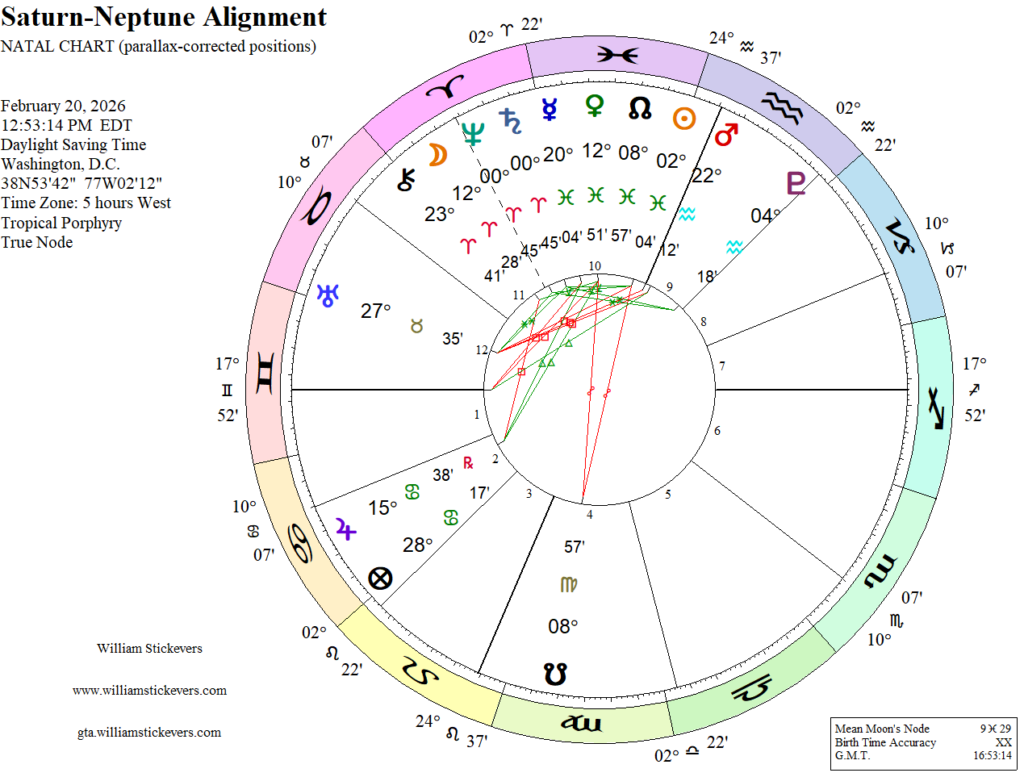
Potential Themes for the 2026 Conjunction
The upcoming Saturn-Neptune conjunction in 2025-2026 marks another significant astrological event, continuing the cycle that historically correlates with periods of profound societal, political, and ideological shifts. Given the patterns observed with past conjunctions, this period could also herald significant transformations on a global scale. While the specific outcomes of this conjunction cannot be predicted with certainty, we can speculate on potential themes based on the archetypal energies of Saturn and Neptune. The interplay between Saturn and Neptune during their conjunction in 2025-2026 could manifest in several ways:
- Societal Structures and Ideals: There may be a tension between the status quo and a push for more idealistic or utopian visions of society. This could lead to significant reforms in institutions that are perceived as outdated or not serving the collective good.
- Environmental Concerns: Given Neptune’s association with the collective and Saturn’s with responsibility, this conjunction could bring increased focus on environmental sustainability, potentially spurring significant policy reforms or technological innovations aimed at combating climate change.
- Economic Reforms: The conjunction might highlight the limitations of current economic systems, prompting discussions and actions towards more sustainable and equitable economic practices, possibly addressing wealth disparities and resource distribution.
- Spiritual Awakening: On a more personal level, this period might be characterized by a collective search for meaning, leading to a spiritual or philosophical awakening for many individuals. There could be a blending of practical spirituality with everyday life, aiming to integrate Neptune’s ideals with Saturn’s reality.
- Artistic and Cultural Expression: The creative realm could see a flourish of activity, with art, music, and literature reflecting the themes of this conjunction, blending realism with idealism to comment on societal issues or envision new possibilities.
Given the profound historical transitions and challenges the Russian Federation has faced since its establishment in 1991, as detailed in the document, the upcoming Saturn-Neptune conjunction in 2025-2026 could potentially signify a period of significant transformation for Russia, both internally and in its external relations.
The conjunction’s influence might manifest through further shifts in political dynamics, economic reforms, or social changes. Historically, such conjunctions have coincided with periods of upheaval, reform, or significant policy shifts, reflecting a dissolution of old forms and the gradual emergence of new paradigms. For Russia, this could involve changes in leadership styles, governance structures, or a reevaluation of its role on the global stage, especially considering its historical pattern of deep structural transformations during or following major astrological alignments.
Additionally, considering Russia’s current geopolitical stance, internal governance challenges, and economic conditions, this period could highlight tensions between maintaining its traditional power structures and adapting to global shifts towards more sustainable, equitable, and transparent governance models. The alignment might also emphasize issues related to environmental sustainability, economic inequality, and the digital transformation of society, pushing these themes to the forefront of national discourse.
In essence, the Saturn-Neptune conjunction could act as a catalyst for Russia to navigate through its internal contradictions and external pressures, potentially leading to a redefinition of its national identity and global role.
Conclusion
The Saturn-Neptune conjunction in 2025-2026 invites us to consider the balance between structure and fluidity, reality and idealism. It challenges us to envision practical ways to implement our highest ideals, recognizing the limitations we face but also the boundless potential for transformation. As with previous conjunctions, this period could act as a catalyst for significant change, encouraging societies to dissolve outdated structures and coalesce around new, more inclusive, and compassionate ways of organizing our collective existence.
Responses