
The Strategic Insight of Prediction Markets: A Comprehensive Analysis for the 2024 General Election

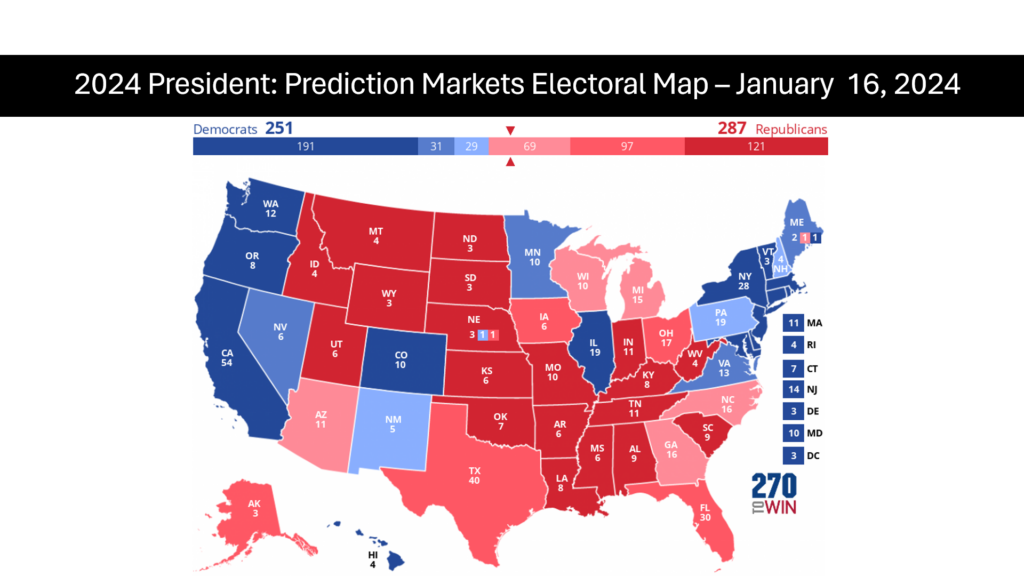
Prediction markets, functioning as open trading platforms, facilitate the forecasting of specific events by incentivizing financial gains. In these markets, participants engage in buying and selling contracts, the value of which is determined by the occurrence or non-occurrence of a particular event. These markets cover a wide array of sectors, including finance, sports, entertainment, and politics.
Renowned for their accuracy, prediction markets capitalize on the collective intelligence of a broad spectrum of contributors. By pooling insights from varied participants, these markets are adept at generating well-informed forecasts.
There are several notable prediction markets such as PredictIt, the Iowa Electronic Markets, and international platforms like Betfair in the United Kingdom.
Research and academic studies have consistently shown that prediction markets often outperform traditional opinion polls and conventional political forecasts. They have been particularly effective in areas beyond politics, such as predicting box office success in the film industry, enhancing weather predictions, and offering valuable insights for corporations and government entities like the Defense Department in matters of security, health care, and product quality.
When compared with aggregated polling data, prediction markets generally show superior accuracy, especially as the time to an event like an election draws nearer.
A key distinction between political polls and prediction markets lies in their approach. While polls gauge current preferences regarding candidates, prediction markets, where real money is at stake, probe into participants’ beliefs about probable outcomes rather than their personal wishes.
This concept is akin to the experience of sports enthusiasts. For example, a lifelong fan of the Mets might consistently hope for their victory. However, when faced with the prospect of a monetary wager, the decision often shifts to a more pragmatic choice, reflecting an understanding of the team’s historical performance rather than personal allegiance.
Prediction markets, given their unique structure and methodology, hold significant potential for providing non-partisan and unbiased insights into the 2024 General Election. These markets operate on the principle of financial incentives, which encourages participants to rely on informed judgment rather than partisan leanings. This approach contrasts with traditional opinion polls, which often reflect current sentiments or party affiliations.
The key to the effectiveness of prediction markets in the political arena lies in their ability to aggregate a wide range of information from a diverse group of participants. This diversity includes individuals with different political views, geographical backgrounds, and levels of expertise. By synthesizing this varied input, prediction markets can offer a more comprehensive and less biased perspective on the probable outcomes of the election.
Furthermore, the requirement for participants to invest real money in these markets adds a layer of seriousness and pragmatism to their predictions. This financial stake prompts participants to consider not just who they wish to win but who they realistically believe will win, based on all available information. This distinction is crucial, as it shifts the focus from personal preference to a more objective assessment of the political landscape.
In the context of the 2024 General Election, prediction markets can thus serve as a valuable tool for gauging the actual state of the political contest. By reflecting the collective intelligence and unbiased assessments of a broad group of individuals, these markets can provide insights that are less susceptible to the biases and limitations inherent in traditional polling methods. As a result, they can offer a more reliable indication of the potential outcomes in November, making them an essential resource for anyone seeking to understand the dynamics of the election without the filter of partisan perspectives.
Responses