
Fifteen Films That Are The Best Representation Of What We Now Face As A Society

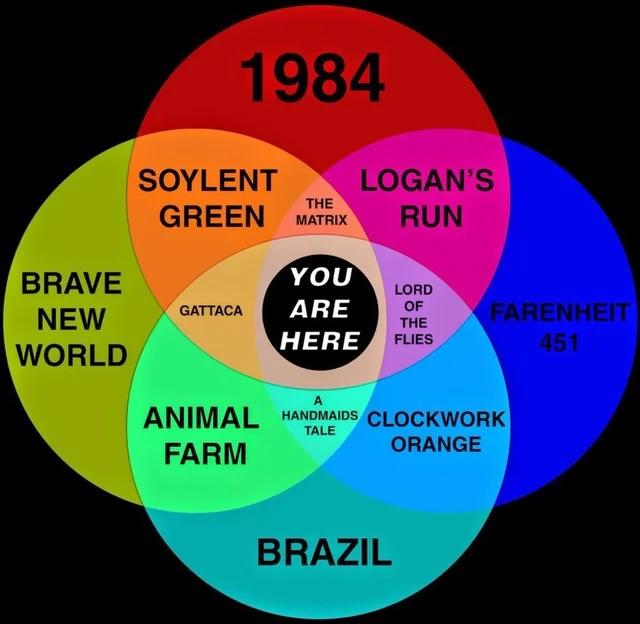
The following films—and the writers who inspired them—understood what many people, caught up in their partisan, flag-waving, zombified states, are still struggling to come to terms with: that there is currently no government organized for the good of the people. For even the best intentions among those in government inevitably give way to the desire to maintain power and control at all costs.

Fahrenheit 451 (1966). Adapted from Ray Bradbury’s novel and directed by Francois Truffaut, this film depicts a futuristic society in which books are banned, and firemen ironically are called on to burn contraband books—451 Fahrenheit being the temperature at which books burn. Montag is a fireman who develops a conscience and begins to question his book burning. This film is an adept metaphor for our obsessively politically correct society where virtually everyone now pre-censors speech. Here, brainwashed people addicted to television and drugs do little to resist governmental oppressors. Bradbury said that he wrote Fahrenheit 451 because of his concerns at the time (during the McCarthy era) about the threat of book burning in the United States. In later years, he described the book as a commentary on how mass media reduces interest in independent reading and the study of literature.

2001: A Space Odyssey (1968). is an epic science fiction film produced and directed by Stanley Kubrick. The screenplay was written by Kubrick and science fiction author Arthur C. Clarke, and was inspired by Clarke’s 1951 short story “The Sentinel” and other short stories by Clarke. Clarke also developed a novelisation of the film, which was released after the film’s release, and in part written concurrently with the screenplay. The film stars Keir Dullea, Gary Lockwood, William Sylvester and Douglas Rain. The plot of Stanley Kubrick’s masterpiece, based on an Arthur C. Clarke short story, revolves around a space voyage to Jupiter. The astronauts soon learn, however, that the fully automated ship is orchestrated by a computer system—known as HAL 9000—which has become an autonomous thinking being that will even murder to retain control of they mission . The idea is that at some point in human evolution, technology in the form of artificial intelligence will become autonomous and human beings will become mere appendages of technology. In fact, at present, we are seeing this development with massive databases generated and controlled by the government that is administered by such secretive agencies as the National Security Agency and sweep all websites and other information devices5 (e.g. iPhone) collecting information on citizens.

Planet of the Apes (1968) an American science fiction media franchise about a world in which humans and intelligent apes clash for control. The franchise is based on French author Pierre Boulle’s 1963 novel La Planète des singes, translated into English as Planet of the Apes or Monkey Planet. In the film 4 American astronauts crash on a planet where apes are the masters and humans are treated as brutes and slaves. While fleeing from gorillas on horseback, astronaut Taylor (Charlton Heston) is shot in the throat, captured, and housed in a cage. From there, Taylor begins a journey wherein the truth revealed is that the planet was once controlled by technologically advanced humans who destroyed civilization. Taylor’s trek to the ominous Forbidden Zone reveals the startling fact that he was on planet earth all along. Descending into a fit of rage at what he sees in the final scene, Taylor screams: “We finally really did it. You maniacs! You blew it up! Damn you.” The lesson is obvious, but will we listen? The script, although rewritten, was initially drafted by Rod Serling and retains Serling’s Twilight Zone-ish ending.

THX 1138 (1971) is an American social science fiction film directed by George Lucas in his feature film directorial debut. It is set in a dystopian future in which the populace is controlled through android police and mandatory use of drugs that suppress emotions. Produced by Francis Ford Coppola and written by Lucas and Walter Murch, it stars Robert Duvall and Donald Pleasence. The film is a somber view of a dehumanized society totally controlled by a police state. The people are force-fed drugs to keep them passive, and they no longer have names but only letter/number combinations such as THX 1138. Any citizen who steps out of line is quickly brought into compliance by robotic police equipped with “pain prods”—electro-shock batons. Sounds alot like tasers, does it not?

A Clockwork Orange (1971). A Clockwork Orange is a dystopian crime film adapted, produced, and directed by Stanley Kubrick, based on Anthony Burgess’s 1962 novel of the same name. It employs disturbing, violent images to comment on psychiatry, juvenile delinquency, youth gangs, and other social, political, and economic subjects in a dystopian near-future Britain. Kubrick presents a future ruled by sadistic punk gangs and a chaotic government that cracks down on its citizens sporadically. Alex (Malcolm McDowell), the central character, is a charismatic, antisocial delinquent whose interests include classical music (especially Beethoven), committing rape, theft, who finds himself in the grinding, crushing wheels of injustice. This film may accurately portray the future of a western society that grinds to a halt as oil supplies diminish, environmental crises increase, and civil unrest and chaos rules the day. The only thing left is brute force.

Soylent Green (1973) is an American ecological dystopian thriller film directed by Richard Fleischer and starring Charlton Heston, Leigh Taylor-Young, and Edward G. Robinson in his final film role. Set in a futuristic overpopulated New York City in 2022, the cumulative effects of overpopulation, pollution, and an apparent climate catastrophe resulting in ecological collapse have caused severe worldwide shortages of food, water, and housing. There are 40 million people in New York City alone, where only the city’s elite can afford spacious apartments, clean water, and natural food. The homes of the elite are fortified, with private security, and bodyguards for their tenants, and usually include concubines (who are referred to as “furniture” and serve the tenants as slaves). The New York population depends on synthetic foods manufactured by the Soylent Corporation. A policeman investigating a murder of a wealthy businessman who discovers the grisly truth about what soylent green is really made of. The theme is chaos where the world is ruled by ruthless corporations whose only goal is the consolidation of political power and resources, rapacious greed, and profit. Sound familiar to the world we live in today?

Blade Runner (1982) is an American science fiction film directed by Ridley Scott and adapted by Hampton Fancher and David Peoples. Starring Harrison Ford, Rutger Hauer, Sean Young, and Edward James Olmos, it is an adaptation of Philip K. Dick’s 1968 novel Do Androids Dream of Electric Sheep? The film is set in a dystopian future Los Angeles of 2019, in which synthetic humans known as replicants are bio-engineered by the powerful Tyrell Corporation to work on space colonies. When a fugitive group of advanced replicants led by Roy Batty (Hauer) escapes back to Earth, a world-weary cop Rick Deckard (Ford), reluctantly agrees to track down a handful of renegade “replicants” (synthetically produced human slaves). Mega-corporations dominate life, and people are gaslit (brainwashed) and sleepwalking (cognitive dissonance) along rain-drenched streets. This is a world where human life is cheap, and anyone can be exterminated at will by the police (or blade runners). The film questions what it truly means to be human in an inhuman world.

Nineteen Eighty-Four (1984), also known as 1984, is a British dystopian science fiction film written and directed by Michael Radford, based upon George Orwell’s 1949 novel of the same name. Starring John Hurt, Richard Burton, Suzanna Hamilton, and Cyril Cusack, the film follows the life of Winston Smith, a low-ranking civil servant in a war-torn London ruled by Oceania, a totalitarian superstate. Smith (Hurt) struggles to maintain his sanity and grip on reality as the regime’s overwhelming power, and influence persecutes individualism and individual thinking on both political and personal levels. The 1984 film is the best adaptation of Orwell’s dark dystopian tale. This film visualizes the total loss of freedom in a world dominated by technology, its misuse, and the crushing inhumanity of an omniscient state. The government controls the masses by controlling their thoughts through applied perception management, social engineering programs, altering history, and changing the meaning of words. Winston Smith is a doubter who turns to self-expression through his diary and then begins questioning the ways and methods of the state, known as Big Brother, before being re-educated most brutally.
Brazil (1985) is a dystopian black comedy film[ directed by Terry Gilliam and written by Gilliam, Charles McKeown, and Tom Stoppard. The film stars Jonathan Pryce and features Robert De Niro, Kim Greist, Michael Palin, Katherine Helmond, Bob Hoskins, and Ian Holm. The film centers on Sam Lowry, a low-ranking bureaucrat trying to find a woman who appears in his dreams while working in a mind-numbing job and living in a small apartment, set in a dystopian world where there is an over-reliance on poorly maintained machines. Brazil‘s satire of technocracy, hyper-surveillance, corporatism, and state capitalism, is reminiscent of the near-future vision of George Orwell’s novel Nineteen Eighty-Four and Franz Kafka’s novel The Trial. This film is arguably director Terry Gilliam’s best work, one replete with a merging of the absurd and stark reality. Here, a mother-dominated, hapless clerk takes refuge in flights of fantasy to escape the ordinary drabness of life. Caught within the chaotic tentacles of a police state and the longing for a more innocent time lies behind the vicious surface of this Kafkaesque and absurdist film.

They Live (1988) is an American science fiction action film written and directed by John Carpenter, based on the 1963 short story “Eight O’Clock in the Morning” by Ray Nelson. Starring Roddy Piper, Keith David, and Meg Foster, the film follows an unnamed drifter who discovers through special sunglasses that the ruling class are aliens concealing their appearance and manipulating people to consume, breed, and conform to the status quo via subliminal messages in mass media such as “obey’ and “conform”. Carpenter’s bizarre action film is a subversive blend of horror and sci-fi social satire that assumes the future has already arrived. The film manages to make an effective political point about the totalitarian dictatorship in democracy, the invisible order which sustains one’s apparent sense of freedom, and the growing underclass of deplorables—that is, everyone except those in power—the political class. The salient point of this film is that people are essentially the prisoners of their own devices, either too busy sucking up the entertainment trivia beamed into their brains and attacking each other, that ultimately prevents the start of an effective resistance movement.

The Matrix (1999) is an American science fiction action film written and directed by the Wachowskis. It is the first installment in The Matrix film series, starring Keanu Reeves, Laurence Fishburne, Carrie-Anne Moss, Hugo Weaving, and Joe Pantoliano. It depicts a dystopian future in which humanity is unknowingly trapped inside a simulated reality, the Matrix, which artifically intelligent machines have created to distract humans while using their bodies as an energy source. The story centers on a computer programmer Thomas A. Anderson, secretly a hacker known by the alias “Neo,” who begins a relentless quest to learn the meaning of “The Matrix”—cryptic references that appear on his computer. Neo’s search leads him to Morpheus who reveals the truth that the present reality is not what it seems and that Anderson is actually living in the future—2199. Humanity is at war against technology which has taken the form of intelligent beings, and Neo is actually living in The Matrix, an illusionary world that appears to be set in the present (1999 in the film) in order to keep the humans docile and under control. Neo soon joins Morpheus and his cohorts in a rebellion against the machines that use SWAT team tactics to keep things under control. The Matrix draws from and alludes to numerous cinematic and literary works, and concepts from mythology, religion and philosophy, including the ideas of Buddhism, Christianity, Gnosticism, Hinduism, and Judaism. The film’s success led to two feature film sequels being released in 2003, The Matrix Reloaded and The Matrix Revolutions, which were also written and directed by the Wachowskis. A fourth film, titled The Matrix Resurrections, was released on December 22, 2021.

Minority Report (2002) is an American science fiction film directed by Steven Spielberg, loosely based on the 1956 short story “The Minority Report” by Philip K. Dick. The film is set in Washington, D.C. and Northern Virginia in the year 2054, where Precrime, a specialized police department, apprehends criminals based on foreknowledge provided by three psychics called “precogs”. The cast stars Tom Cruise as Precrime Chief John Anderton, Colin Farrell as Department of Justice agent Danny Witwer, Samantha Morton as precog Agatha Lively, and Max von Sydow as Precrime director Lamar Burgess. The film combines elements of tech noir, whodunit, thriller and science fiction genres, as well as a traditional chase film, as the main protagonist is accused of a crime he has not committed and becomes a fugitive. Minority Report offers a techno-vision of a futuristic world in which the government is all-seeing, all-knowing, and all-powerful. And if you dare to step out of line, dark-clad police SWAT teams will bring you under control. This film raises the issue of the danger of technology operating autonomously—which will happen eventually if it has not already occurred. To a hammer, all the world looks like a nail. In the same way, to a police state computer, we all look like suspects. In fact, before long, we all may be mere extensions or appendages of the police state—all suspects in a world commandeered by machines.

V for Vendetta (2005) is a dystopian political action film directed by James McTeigue (in his feature directorial debut) from a screenplay by the Wachowskis. It is based on the 1988 DC Vertigo Comics limited series of the same title by Alan Moore and David Lloyd. The film is set in a future where a fascist totalitarian regime has subjugated the UK. It centers on the character V (portrayed by Hugo Weaving), an anarchist and masked freedom fighter who attempts to ignite a revolution through elaborate terrorist acts. Evey Hammond (portrayed by Natalie Portman) is a young woman caught up in V’s mission. Stephen Rea portrays a detective leading a desperate quest to stop V. This film depicts a society ruled by a corrupt and totalitarian government where an abusive and secret police force runs everything. A vigilante named V dons a mask and leads a rebellion against the state. The subtext here is that authoritarian regime, through repression, create their enemies—that is, terrorists—forcing government agents and terrorists into a recurring cycle of violence. And who is caught in the middle? The citizens, of course. This film has a cult following among various underground political groups, such as Anonymous, whose members wear the same Guy Fawkes mask as that worn by V.

Children of Men (2006) is a dystopian action thriller film co-written and directed by Alfonso Cuarón. Based on P. D. James’ 1992 novel The Children of Men, the screenplaywas credited to five writers, with Clive Owen making uncredited contributions. The film takes place in 2027 when two decades of human infertility have left society on the brink of collapse. Asylum seekers seek sanctuary in the United Kingdom, where they are subjected to detention and refoulement by the government. Owen plays civil servant Theo Faron, who must help refugee Kee (Clare-Hope Ashitey) escape the chaos. Children of Men also stars Julianne Moore, Michael Caine, Chiwetel Ejiofor, Pam Ferris, and Charlie Hunnam. This film portrays a futuristic world without hope since humankind has lost its ability to procreate. Civilization has descended into chaos and is held together by a military state and a government attempting to keep its totalitarian stronghold on the population. Most governments across the world have collapsed, leaving Great Britain as one of the few remaining intact societies. As a result, millions of refugees seek asylum only to be rounded up and detained by the police. Suicide is a viable option as a suicide kit called Quietus is promoted on billboards, television, and newspapers. But hope for a new day comes when a woman becomes inexplicably pregnant.

Land of the Blind (2006) is a British-American dark political satire, based on several incidents throughout history in which tyrannical rulers were overthrown by new leaders who proved to be just as bad, if not worse, and several such cases are alluded to. The title is taken from the saying, “In the kingdom of the blind, the one-eyed man is king. Starring Ralph Fiennes, Donald Sutherland, Tom Hollander and Lara Flynn Boyle. Historical references in the film include Jean-Paul Marat (from the French Revolution), Kim Jong-Il, Joseph Stalin, Benito Mussolini, Augusto Pinochet, Anastasio Somoza Debayle, François Duvalier, Rudolf Hess, Jean-Claude Duvalier, Lyndon B. Johnson, Julius Caesar (from William Shakespeare’s play), Robert Mugabe, Ngo Dinh Diem, Idi Amin, the PIRA Maze prison protests, U.S. POWs in Vietnam, the Weathermen terrorist group, the Khmer Rouge, the 1979 Revolution in Iran, and the subsequent Cultural Revolution in that country.
Do you have a movie that will represent our future? Our “rebirth” process I hope it will be better than the ending of H.G. Wells’ “Time Machine.”