
Coinbase Listing of DOT Boost Polkadot 16%


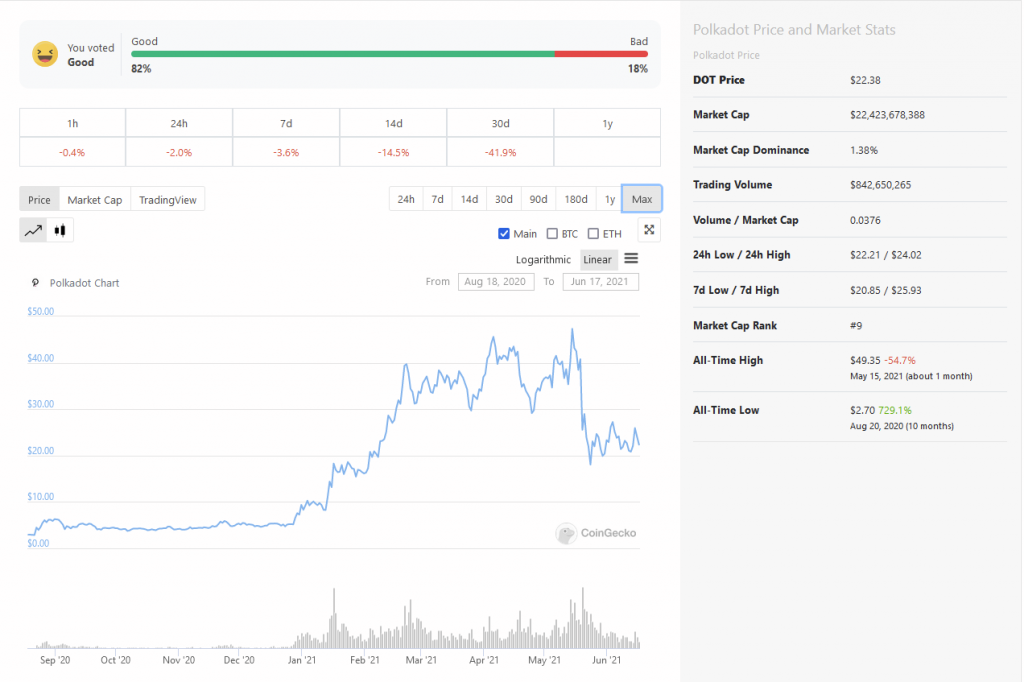
The eighth-largest cryptocurrency by market capitalization has enjoyed a hefty boost after Coinbase Pro announced it would list Polkadot’s DOT token on the exchange.
Coinbase has begun trading DOT, the native token for Polkadot. A blog post reported that inbound transfers have already begun, and trading kicked off on June 16th.
DOT has since risen by more than 16%, thanks to what is commonly called the “Coinbase effect.” In a report from Messari, an analysis outlet, the average returns five days after a token listing on Coinbase is 91%.
This is far higher than a listing on competitor exchanges like Binance, Kraken, FTX, Gemini, and Okex, reports Messari.
Polkadot is a “multi-chain” platform that is looking to bring together siloed networks. Bitcoin and Ethereum, for example, cannot interact with one another because they are built using different technologies. This lack of interoperability is common throughout the crypto sector.
This silo system has kept these networks secure, but as the world of blockchain has grown, challenges and choke points have started to appear. Take Ethereum for example. While it has arguably the largest ecosystem of any other blockchain, those projects and companies that are built upon it have to abide by the rules of Ethereum.
If a project wanted to pay fewer fees to move data around the network, it can’t. If it wanted to speed up the pace by which the underlying blockchain validates the blocks, it can’t.
While there are now a whole host of other blockchains and ecosystems that have worked on solving some of the problems faced by builders on Ethereum, moving data, tokens, and audiences is time-consuming and potentially very expensive. That’s where blockchain bridges come in.
Built by Ethereum co-founder Gavin Wood, Polkadot is just one project hoping to address this with its goal is to build a ‘blockchain of blockchains’, by allowing sovereign blockchains like Ethereum and Bitcoin for instance to operate through what Polkadot calls ‘parachains,’ to enable them to be interoperable with other projects, via Polkadot’s Relay Chain. So in this example, Bitcoin and Ethereum could have a bridge built between them on Polkadot.
Thorchain, Cosmos, and Solana are also competing in this market.
However, Wood’s technology is still several steps from achieving its objective.
Before launching, each component is first launched and tested on Polkadot’s so-called “canary network.” This canary network is a testnet of sorts called Kusama. Kusama offers an environment in which each part of the Polkadot network can be tested before it goes into production.
These days, the team has been launching new tests on Kusama regularly too. Parachains, the spokes of this multi-chain wheel of blockchains, have already launched on Kusama, albeit in a reduced capacity. The next step is something called a parachain auction, in which different projects bet to earn a spot in the Kusama environment.
These auctions will continue deep into July, writes Wood.
Now, thanks to Coinbase, users can speculate on both Kusama and Polkadot’s native token while they wait.

Love DOT. Own lots of it