
Iran’s Bitcoin Bet and the Money Wars to Come

Iran’s push to license bitcoin mining could help it evade U.S. sanctions. But the plan is likely to help some of its people more than others.
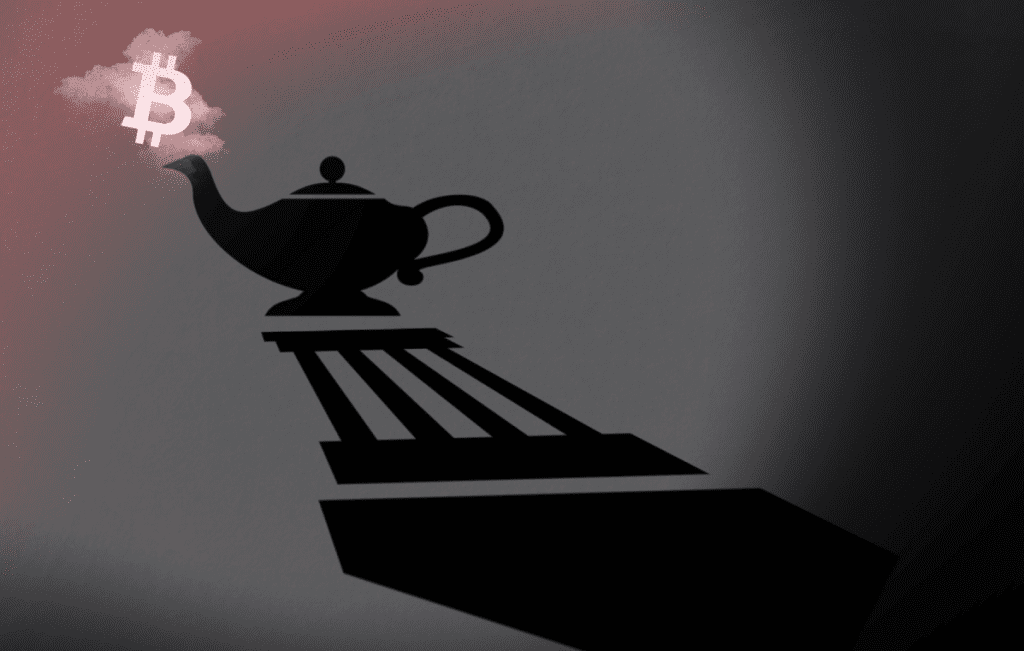
Iran is the Cuba of the Crypto Age
News this week that Iran will allow a small set of qualified entities to pay for imports with cryptocurrency mined by licensed operators might sound like an enlightened move to bitcoin enthusiasts.
It fits a narrative that when governments start accepting bitcoin, they jump-start its role as a universal reserve asset. Meanwhile, the free trade-minded who chafe at all government intervention in markets may view Iran’s use of bitcoin to get around U.S. sanctions as a positive blow for global commerce generally.
But look closer and you’ll see in Iran’s bitcoin strategy the hallmarks of an authoritarian system that flouts the freedoms crypto advocates like to embrace. When viewed alongside a crackdown against unlicensed crypto mining, the regime’s moves could widen the divide between government-favored elites and average Iranians.
It’s not clear if federal officials in Washington will care about that inequity. But it will view Iran’s bitcoin solution for sanction avoidance with alarm, as it undermines the United States’ self-appointed role as cop to the global financial system. Concerns about that will be amplified if it’s apparent that China, which is eager to knock the U.S. dollar off its international reserve currency perch, is directly or indirectly supporting Iran’s approach (The pathways for Beijing to do so by 2025 have already laid out).
The question is: How should the Biden administration respond? By rolling this into a simplistic “bitcoin bad” narrative and imposes tighter controls on the cryptocurrency’s users in the U.S. and elsewhere. A more constructive approach, that would encourage Iran to abandon its strategy for a crypto policy that favors fair participation for innovation, green infrastructure, and economic freedom for all its citizens.
Some miners more equal than others
The intent of the government of President Hassan Rouhani is hardly a mystery.
Even though Iran is a major oil producer, years of crippling U.S. sanctions aimed at containing its nuclear weapons program have deprived its economy of dollars. That makes it very difficult for Iran to buy what it needs from the world, and ensures that the local currency, the rial, is under perpetual downward pressure, which in turn stokes high-levels of inflation.
Now, by creating a legal framework in which bitcoin can be mined locally, taxed under a strict licensing system and used by regulated institutions to pay for imports, the government has a workaround. Iran will still struggle to sell its energy resources for dollars, but it can do the next best thing: It can convert that same local resource into bitcoin, a harder currency than U.S. dollars.
At the same time, the regime is showing its authoritarian instincts. In January, it said that Iran had 24 officially registered mining farms, consuming 310 megawatts of power, and that the Ministry of Energy had shut down 1,620 illegal bitcoin mining operations with a capacity of 250 megawatts over the prior 18 months. It offered rewards of up to 100 million rials ($2,350) for information leading to the arrest of illegal bitcoin miners.
In a subsequent story by CoinDesk’s Anna Baydakova, one household miner, “Basir” (not his real name), said he spent a week in jail before he could scrounge up the large bail amount by selling his house, his car and his mining equipment.
The premise for the crackdown is that illegal mining is disrupting Iran’s overstretched electricity grid. But bitcoin advocates say that is unfair as the country’s blackouts have continued even after the authorities have done their sweep.
Regardless, by making itself the gatekeeper for domestically mined bitcoin and discriminating over which entities can access it, the government is laying the groundwork for societal divisions – especially if bitcoin grows in importance, as many expect it will.
To understand why, let’s go back to the early years of the post-Cold War era in Cuba, another country that has labored under the constraints of U.S. sanctions.
Cuba’s lesson
In 1993, Fidel Castro’s regime was broke. Its longtime benefactor, the Soviet Union, had collapsed and the island economy was reeling from four years of “Special Period” austerity.
Castro reluctantly adopted a radical solution: He legalized the use of U.S. dollars, but only within designated, closely regulated industries such as government-sanctioned tourism resorts that could only accept foreigners as guests. It later entrenched this system by requiring all incoming foreign currency, including that carried by foreign tourists, be exchanged into “convertible Cuban pesos,” a new local currency pegged one-to-one with the dollar. The new notes would circulate in parallel with the traditional Cuban peso, known as “moneda nacional” (national currency), but could only be used in those same sanctioned settings.
The strategy gave the regime a lifeline. With taxes from regulated foreign currency inflows, it continued to defy the Helms-Burton Act, a a United States federal law which continues the United States embargo against Cuba. The act extended the territorial application of the initial embargo to apply to foreign companies trading with Cuba, and penalized foreign companies allegedly “trafficking” in property formerly owned by U.S. citizens but confiscated by Cuba after the Cuban revolution. The act also covers property formerly owned by Cubans who have since become U.S. citizens.
But the system created two Cubas, one where a privileged elite got access to goods and services available only in de facto foreign currency. Everyone else earned near-worthless moneda nacional, which could buy only items listed on the “libreta,” or ration book, an artifact of Soviet communism that guaranteed necessities such as bread and milk but excluded anything deemed to be a “luxury” – in effect, anything imported. To give you an idea of how limiting the libreta was, it did not include the “luxury” of tampons.
These deep divisions also bred rampant corruption because goods designated for the moneda nacional economy were hoarded and sold illegally in the convertible peso economy.
Bakers would secretly deliver half their production to fancy foreign tourist-only restaurants, denying libreta holders their bread rations. Gas stations would siphon off gasoline intended for domestic customers and deliver it to companies operating in the convertible peso economy. Painters would thin out their paint so that they could sell half their supplies to hotels that would pay them in Cuban pesos.
The system created a new class of predominantly white elites whose expat families in Miami, Florida and Madrid , Spain would send them foreign currency, while doing nothing for a disproportionately black community without such ties.
By the standards of Communist Cuba’s professed egalitarian ideals, it was an abomination. Yet, it took the government 28 years – until January of this year – to unify the currencies. Such was the intoxicating appeal of this unjust system for the Castro dictatorship – first under Fidel, then under his brother, Raul, who recently step down.
A different path?
Similar inequity lies ahead for Iran if it sticks with its crypto strategy and, as many of us believe, bitcoin becomes a sought-after store of value in a post-COVID era of high debt, slow growth, and fiat currency purchasing-power depreciation. Some Iranians will become phenomenally rich. Others will be stuck with worthless rials. Attempts to cross the divide will encourage corruption and social tensions.
Still, for the Iranian regime, the strategy is a tempting way to fund itself. Also, given Iran’s relationship with China – with which it recently struck a $400 billion, 25-year investment deal that included access to Iranian oil and a plan for a bi-national “bank” – it presents an opportunity to shift the geopolitical landscape.
China has the largest bitcoin mining industry in the world, and so it’s not hard to imagine Chinese bitcoin miners building officially endorsed, fossil fuel-run facilities inside Iran. Once bilateral payment agreements are in place to use digital currencies that bypass the U.S.-led global financial system, one can foresee a feedback loop in which China gets oil from Iran, Iran gets hard currency from China that they can swap for gold, the U.S. dollar’s power is diminished, and bitcoin’s carbon footprint grows.
How should the U.S. respond?
My fear is the rallying cry in Congress will be that bitcoin is “enabling” reprehensible sanctions-busting behavior, prompting calls for tougher crypto regulations. That will only drive more activity underground and encourage more dirty fuel installations in Iran and elsewhere – in effect, strengthening the regime’s hand.
The alternative is the U.S. government takes a more constructive approach, encouraging innovation and economic freedom. It could offer to work with domestic bitcoin miners to commit to zero greenhouse emissions and, in so doing, develop such energy sources, whether it’s the government’s nuclear plants or locally run solar and wind operations.
Responses