
Giuliani Turns Over Photos Of Underage Girls From Hunter’s Hard Drive To Delaware Police

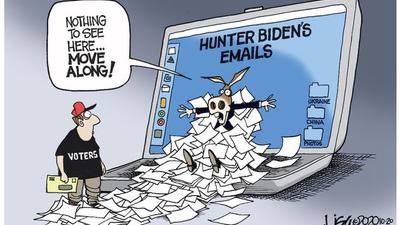
Things just took a very dark turn in the Hunter Biden laptop scandal. While the alleged crack, cronyism, corruption was enough to spark the biggest media suppression in history, and no denials whatsoever from the Biden camp, the bombshell that Rudy Giuliani just dropped, if true, is egregious, to say the least (not just with regard Hunter Biden but the law enforcement authorities who have allegedly had this information since before Trump’s impeachment but done nothing about it). Not just with regard to Hunter Biden but the law enforcement authorities who have had this information since before Trump’s impeachment but done nothing about it.
In an interview, this evening with Newsmax TV, former NYC Mayor, and current attorney to President Donald Trump, Rudy Giuliani announce he has turned over Hunter Biden’s laptop hard-drive to Delaware State Police due to pictures of underage girls and inappropriate text messages. In one of the texts, Hunter Biden allegedly says to his sister-in-law (also his lover) that he face-timed a 14-year-old girl while naked and doing crack – “she told my therapist that I was sexually inappropriate.” Giuliani adds, “this would be with regard to an unnamed 14-year-old girl,” adding that “this is supported by numerous pictures of underage girls.”Furthermore, JustTheNews’ John Solomon reports that former New York Police Department commissioner Bernard Kerik joined him when he delivered photographs and text messages to the New Castle County Police Department.
In one of the texts, Hunter Biden allegedly says to his sister-in-law (also his lover) that he face-timed a 14-year-old girl while naked and doing crack – “she told my therapist that I was sexually inappropriate.”Giuliani adds, “this would be with regard to an unnamed 14-year-old girl,” adding that “this is supported by numerous pictures of underage girls.”Furthermore, JustTheNews’ John Solomon reports that former New York Police Department commissioner Bernard Kerik joined him when he delivered photographs and text messages to the New Castle County Police Department.
“I told them other details about what appears to be an inappropriate sexual relationship,” he said in an interview. “They told me it would be investigated.”Law enforcement officials in Delaware told Just the News that Giuliani’s concerns have been forwarded to the state Department of Justice.”The FBI has had this for a long time,” Giuliani said.”No indication they did anything about this, so I went to the local police and said, ‘What are you going to do about this?'”
“I told them other details about what appears to be an inappropriate sexual relationship,” he said in an interview. “They told me it would be investigated.”
“I will tell you the evidence I gave them states it was reported to Joe Biden. What did he do about it?”Before this is wholly dismissed as yet more Russian disinformation or ‘Giuliani’ lies, we remind readers that that Hunter Biden’s alleged laptop contents included a curious piece of evidence – a photograph of an FBI subpoena which bears the signature of the agency’s top child porn investigator, special agent Joshua Wilson.FBI agent Wilson’s identity was confirmed by both Western Journal and Business Insider, the latter of which compared his signature to a 2012 criminal complaint and concluded that it “clearly matches the unreversed signature on the subpoena published by the New York Post.”
I am so glad I’ve suscribed to GTA William! I am convinced that Steve Bannon listens to you!
Sad, very sad.
Fortunately, there is a Higher Court that Knows ALL…
These people, such as the Biden, Corey, the DOJ, DOS & CIA and those colluding and covering up for these political personalities and families who perpetrate such dastardly acts will NOT GO UNPUNISHED…but will be eternally damned.
YES & AMEN!
Just an FYI Marshall, ITS CONSPIRACY, NOT COLLUSION!!! There is No Such “Legal Term, or Legal Law On Collusion”, they KEEP LOUDLY Puttng that Narrative Out There So that if THEY Get Caught It is a “TECHNICALITY” that the “BLACK HATS” ALWAYS USE TO GET OFF ON!!! SAY CONSPIRACY AND THEY JUMP ALL OVER YOU BECAUSE THEY ARE SCARED TO DEATH OF THE DEATH PENALTY AND THEY KNOW THAT WHAT THEY ARE DOING IS CONSPIRACY….
“CONSPIRING TO OVERTHROW THE AMERICAN GOVERNMENT” IS PUNISHABLE BY DEATH, AS TO OF WHICH WE DO HAVE AN ENTIRE BODY OF LAW THAT VERY WELL AND VERY CLEARLY DEFINES THIS!!!
RICO ACT
UNDER RICO ACT : When a court becomes a Criminal Enterprise:
Criteria for Criminal Racketeering Enterprise
Title 42 USC § 1961. Definition. As used in this chapter-(1) “racketeering activity” means:
(A) any act or threat involving … relating to 1503 (relating to obstruction of justice), section 1510 (relating to obstruction of criminal investigations), section 1511 (relating to obstruction of State or local law enforcement), section 1951 (relating to interference with commerce, robbery or extortion), section 1952 (relating to racketeering,
(B) Aiding and Abetting and Conspiracy Against the Rights of Citizens.
Title 42 USC § 1962. Prohibited Activities.
(b) It shall be unlawful for any person through a pattern or racketeering activity or through collection of an unlawful debt to acquire or maintain, directly or indirectly, any interest in or control of any enterprise which is engaged in, or the activities of which affect, interstate or foreign commerce.
(c) It shall be unlawful for any person employed by or associated with any enterprise engaged in, or the activities of which affect, to conduct or participate, directly or indirectly, in the conduct of such enterprise’s affairs through a pattern of racketeering activity or collection of unlawful debt.
(d) It shall be unlawful for any person to conspire to violate any of the provisions of subsections (a), (b), or (c) of this section. …
Controlling Case Law Addressing Government Bodies as RICO Participants
Controlling case law holds that government bodies whose conduct meets the definitions as applied to non-government entities also applies to them. that would include state judges, federal judges, U.S. Department of Justice, and others. INCLUDES: Aiding and Abetting and Conspiracy Against the Rights of
Citizens)
A line of cases hold that any governmental agency, court, political office or the like could serve as a RICO “enterprise.” United States v. Thompson, 685 F.2d 993, 999 (6th Cir. 1982)(en banc) cert. denied, 459 U.S. 1072 (1983). Among the government units that have been held to be “enterprises” are offices of governors and state legislators, courts, court clerks’ offices. See e.g., United States v. Stratton, 649 F.2d 1066, 1072-75 (5th Cir. 1981); United States v. Clark, 656 F.2d 1259, 1261-67 (8th Cir. 1981) Office of county judge); United States v. Frumento, 405 F. Supp. 23, 29-30 (E.D. Pa. 1975), affd, 563 F.2d 1083 (3d Cir. 1977). cert, debued, 434 U.S. 1072 (1978).
Decisions after Frumento expanded government activity to every conceivable government agency, court, or political office. United States v. Thompson, 669 F.2d 1143 (6th Cir), revd 685 F.2d 993 (6th Cir. 1982)(en banc), cert. denied, 459 U.S. 1072 (1983)
· Each of these criminal acts were compounded by the fact that they were perpetrated by people in positions of trust, who were paid to enforce the law.
· Expanding on the number of parties involved in the series of predicate acts were the unknown−but suspected−U.S. Department of Justice−parties that were orchestrating the multiple schemes and conspiracies and protecting each of the criminal acts of each and every one.
Title 18 U.S.C. § 1962(a) provides:
Title 18 U.S.C. § 1962(d) makes it “unlawful for any person to conspire to violate any of the provisions of subsections (a), (b), or (c) of this section.”
In Beauford v. Helmsley, ___ S. Ct. ____ (1989), the Supreme Court held that it is not necessary to prove that multiple schemes, episodes or transactions occurred in order to establish a “pattern of racketeering activity,” as long as the racketeering acts were “neither isolated nor sporadic.”
Mail and wire fraud were a part of the scheme, as defendants used the mails and telephone to carry out their schemes. The mails were used in filing court papers, used to notify plaintiff of these filings, More than two, actually dozens of instances, of such mail and wire fraud occurred, in a pattern of racketeering activity.
In H.J. Inc. v. Northwestern Bell Telephone Co. vs. U.S. (June 26, 1989), the court held:
The Racketeer Influenced and Corrupt Organizations aCt (RICO), 18 U.S.C. ‘ 1961-1968, which is Title IX of the Organized Crime Control Act of 1970 (OCCA), imposes criminal and civil liability upon persons who engage in certain “prohibited Activities,” each of which is defined to include, as a necessary element, proof of a “pattern of racketeering activity.” ‘ 1962. “Racketeering activity” means “any act or threat involving” specified state law crimes, any “act” indictable under specified federal statutes, and certain federal “offenses.” ‘ 1961(1). A “pattern” requires “at least two acts of racketeering activity” within a 10-year period. ‘ 19651(5).
Continuity of racketeering activity likewise may be demonstrated in a variety of ways. Continuity is centrally a temporal concept, and may be either closed−or open-ended. A party alleging a RICO violation may demonstrate continuity over a closed period by proving a series of related predicates extending over a substantial period of time.
(c) Neither RICO’s language nor its legislative history supports a rule that a defendant’s racketeering activities form a pattern only if they are characteristic of organized crime. No such restriction appears in RICO’s test. Nor is there any language suggesting that RICO’s scope should be limited to acts of an association rather than an individual acting alone.
RICO Requires no more than a slight effect upon interstate commerce. United States v. Doherty, 867 F.2d 47, 68 (1st Cir. 1989). United States v. Murphy, 768 F.2d 1518, 1531 (7th Cir. 1985). cert. denied, 106 S.Ct. 1188 (1986).
The racketeering activity is not required to benefit the enterprise. The participants in the scheme are not required to have personally profited, though some did. United States v. Killip, 819 F.2d 1542, 1`549 (10th Cir. 1987.
Congress limited the force of Rule 8(b) by loosening the statutory requirements for what constitutes joint criminal activities. United States v. Friedman, 854 F.2d 535, 561 (2d Cir. 1988); United States v. Castellano, 610 F.Supp. 1359, 1396 (S.D.N.Y. 1985). If a defendant is not named in a conspiracy or RICO count, he may be charged in a separate court, in the same indictment, if he is alleged to have participated in the same series of acts or transactions that constituted the conspiracy or RICO offense.
Civil Liability
Section 1964(c) of the RICO Act also allows civil claims against anyone accused of a RICO violation. When a civil RICO claim is successfully established, the injured person automatically receives a judgment of three times the amount of their actual damages, plus legal fees.
Racketeering activity under federal law includes a number of criminal offenses, including: Bribery; sports bribery; counterfeiting; felony theft from interstate shipment; Embezzlement from Pension and Welfare funds; extortionate credit transactions; Fraud relating to identification documents; fraud relating to access devices; transmission of gambling information; Mail Fraud; wire fraud; financial institution fraud; citizenship or naturalization fraud; obscene matter; Obstruction of Justice; obstruction of criminal investigation; obstruction of state or local law enforcement; witness tampering; retaliation against witness; interference with commerce, bribery, or extortion; interstate transportation in aid of racketeering; interstate transportation of wagering paraphernalia; unlawful welfare fund payments; prohibition of illegal gambling business; Money Laundering; monetary transactions in property derived from unlawful activities; murder for hire; sexual exploitation of children; interstate transportation of stolen motor vehicles; interstate transportation of stolen property; sale of stolen goods; trafficking in motor vehicles and parts; trafficking in contraband cigarettes; white slave traffic; restrictions of payments and loans to labor organizations; embezzlement from union funds.
RICO outlaws every manner in which an enterprise can be used for long-term racketeering activity. Under the law, no person may invest racketeering proceeds to acquire any interest in an enterprise; no person may acquire or maintain an interest in an enterprise through a pattern of racketeering activity; and no person associated with or employed by an enterprise may conduct that enterprise’s affairs through a pattern of racketeering activity.
The punishment for violating the criminal provisions of RICO is exceptionally severe. If convicted, a defendant is fined and sentenced to not more than 20 years in prison for each RICO violation. Furthermore, the defendant must forfeit any interest, claim against, or property or contractual right over the criminal enterprise, as well as any property that constitutes the racketeering activity or that was derived from the racketeering activity. Finally, RICO contains civil provisions that allow a party who has been injured by a RICO defendant to recover from the defendant in civil court. A successful civil RICO plaintiff may collect treble damages, or three times the amount lost to the defendant, as well as attorney’s fees and other costs associated with the litigation. The intent of the many and various sanctions is to cripple, and ultimately eradicate, organized crime enterprises.
RICO employs broad definitions to sweep a wide variety of enterprise criminal activity into its purview. One of the original goals of RICO was to eliminate organized-crime families. However, because Congress could not legislate against specific persons or families, it was forced to use broad language to define racketeering and organized crime. The far-reaching language of the statute has subjected a wide range of criminal defendants to RICO’s penalties. The typical RICO defendant is far from the stereotypical violent mobster. A RICO defendant can be anyone who uses a business (including courts of law) in any way to commit two or more of the many Racketeering Offenses.
25% of votes have already been cast. I just hope people have their eyes wide open and know whom they are voting for. Our country’s future is really at stake.
Now I am convinced that the entire Russian collusion and impeachment was basically to cover up Joe Biden and Democrats Collusion. They will now keep saying that this is a witch hunt by Trump and Russia. When will our Country wake up?
I Know its Mercury Retro Grade and All, Ummm FBI Agents and Attorney Generals CANNOT Issue a Subpeona, ONLY A JUDGE CAN ISSUE A WRITTEN ORDER OR Called A Subpeona and Or A Warrant ! A Federal Agent or State Police Officer CANNOT JUST ISSUE SUBPEONAS!!! This Has to Be A Written Request And Submitted as a Motion to the Courts and A Judge Must Grant or Deny the Motion/Subpeona by Signature As A Judge is the O nly Legal Official That Has Been Granted the Governing Authority to Do So! …..JUST THIS IN OF ITSELF THIS IS GROSS NEGLEGENCE BY THE FBI AGENT PROBABLY TO DELIBERATLTLY OBSTRUCT AND AID IN THE MIS-CARRIAGE OF JUSTICE!!! VERY UPSETTING!!!
Well said
RICO ACT
UNDER RICO ACT : When a court becomes a Criminal Enterprise:
Criteria for Criminal Racketeering Enterprise
Title 42 USC § 1961. Definition. As used in this chapter-(1) “racketeering activity” means:
(A) any act or threat involving … relating to 1503 (relating to obstruction of justice), section 1510 (relating to obstruction of criminal investigations), section 1511 (relating to obstruction of State or local law enforcement), section 1951 (relating to interference with commerce, robbery or extortion), section 1952 (relating to racketeering,
(B) Aiding and Abetting and Conspiracy Against the Rights of Citizens.
Title 42 USC § 1962. Prohibited Activities.
(b) It shall be unlawful for any person through a pattern or racketeering activity or through collection of an unlawful debt to acquire or maintain, directly or indirectly, any interest in or control of any enterprise which is engaged in, or the activities of which affect, interstate or foreign commerce.
(c) It shall be unlawful for any person employed by or associated with any enterprise engaged in, or the activities of which affect, to conduct or participate, directly or indirectly, in the conduct of such enterprise’s affairs through a pattern of racketeering activity or collection of unlawful debt.
(d) It shall be unlawful for any person to conspire to violate any of the provisions of subsections (a), (b), or (c) of this section. …
Controlling Case Law Addressing Government Bodies as RICO Participants
Controlling case law holds that government bodies whose conduct meets the definitions as applied to non-government entities also applies to them. that would include state judges, federal judges, U.S. Department of Justice, and others. INCLUDES: Aiding and Abetting and Conspiracy Against the Rights of
Citizens)
A line of cases hold that any governmental agency, court, political office or the like could serve as a RICO “enterprise.” United States v. Thompson, 685 F.2d 993, 999 (6th Cir. 1982)(en banc) cert. denied, 459 U.S. 1072 (1983). Among the government units that have been held to be “enterprises” are offices of governors and state legislators, courts, court clerks’ offices. See e.g., United States v. Stratton, 649 F.2d 1066, 1072-75 (5th Cir. 1981); United States v. Clark, 656 F.2d 1259, 1261-67 (8th Cir. 1981) Office of county judge); United States v. Frumento, 405 F. Supp. 23, 29-30 (E.D. Pa. 1975), affd, 563 F.2d 1083 (3d Cir. 1977). cert, debued, 434 U.S. 1072 (1978).
Decisions after Frumento expanded government activity to every conceivable government agency, court, or political office. United States v. Thompson, 669 F.2d 1143 (6th Cir), revd 685 F.2d 993 (6th Cir. 1982)(en banc), cert. denied, 459 U.S. 1072 (1983)
· Each of these criminal acts were compounded by the fact that they were perpetrated by people in positions of trust, who were paid to enforce the law.
· Expanding on the number of parties involved in the series of predicate acts were the unknown−but suspected−U.S. Department of Justice−parties that were orchestrating the multiple schemes and conspiracies and protecting each of the criminal acts of each and every one.
Title 18 U.S.C. § 1962(a) provides:
Title 18 U.S.C. § 1962(d) makes it “unlawful for any person to conspire to violate any of the provisions of subsections (a), (b), or (c) of this section.”
In Beauford v. Helmsley, ___ S. Ct. ____ (1989), the Supreme Court held that it is not necessary to prove that multiple schemes, episodes or transactions occurred in order to establish a “pattern of racketeering activity,” as long as the racketeering acts were “neither isolated nor sporadic.”
Mail and wire fraud were a part of the scheme, as defendants used the mails and telephone to carry out their schemes. The mails were used in filing court papers, used to notify plaintiff of these filings, More than two, actually dozens of instances, of such mail and wire fraud occurred, in a pattern of racketeering activity.
In H.J. Inc. v. Northwestern Bell Telephone Co. vs. U.S. (June 26, 1989), the court held:
The Racketeer Influenced and Corrupt Organizations aCt (RICO), 18 U.S.C. ‘ 1961-1968, which is Title IX of the Organized Crime Control Act of 1970 (OCCA), imposes criminal and civil liability upon persons who engage in certain “prohibited Activities,” each of which is defined to include, as a necessary element, proof of a “pattern of racketeering activity.” ‘ 1962. “Racketeering activity” means “any act or threat involving” specified state law crimes, any “act” indictable under specified federal statutes, and certain federal “offenses.” ‘ 1961(1). A “pattern” requires “at least two acts of racketeering activity” within a 10-year period. ‘ 19651(5).
Continuity of racketeering activity likewise may be demonstrated in a variety of ways. Continuity is centrally a temporal concept, and may be either closed−or open-ended. A party alleging a RICO violation may demonstrate continuity over a closed period by proving a series of related predicates extending over a substantial period of time.
(c) Neither RICO’s language nor its legislative history supports a rule that a defendant’s racketeering activities form a pattern only if they are characteristic of organized crime. No such restriction appears in RICO’s test. Nor is there any language suggesting that RICO’s scope should be limited to acts of an association rather than an individual acting alone.
RICO Requires no more than a slight effect upon interstate commerce. United States v. Doherty, 867 F.2d 47, 68 (1st Cir. 1989). United States v. Murphy, 768 F.2d 1518, 1531 (7th Cir. 1985). cert. denied, 106 S.Ct. 1188 (1986).
The racketeering activity is not required to benefit the enterprise. The participants in the scheme are not required to have personally profited, though some did. United States v. Killip, 819 F.2d 1542, 1`549 (10th Cir. 1987.
Congress limited the force of Rule 8(b) by loosening the statutory requirements for what constitutes joint criminal activities. United States v. Friedman, 854 F.2d 535, 561 (2d Cir. 1988); United States v. Castellano, 610 F.Supp. 1359, 1396 (S.D.N.Y. 1985). If a defendant is not named in a conspiracy or RICO count, he may be charged in a separate court, in the same indictment, if he is alleged to have participated in the same series of acts or transactions that constituted the conspiracy or RICO offense.
Civil Liability
Section 1964(c) of the RICO Act also allows civil claims against anyone accused of a RICO violation. When a civil RICO claim is successfully established, the injured person automatically receives a judgment of three times the amount of their actual damages, plus legal fees.
Racketeering activity under federal law includes a number of criminal offenses, including: Bribery; sports bribery; counterfeiting; felony theft from interstate shipment; Embezzlement from Pension and Welfare funds; extortionate credit transactions; Fraud relating to identification documents; fraud relating to access devices; transmission of gambling information; Mail Fraud; wire fraud; financial institution fraud; citizenship or naturalization fraud; obscene matter; Obstruction of Justice; obstruction of criminal investigation; obstruction of state or local law enforcement; witness tampering; retaliation against witness; interference with commerce, bribery, or extortion; interstate transportation in aid of racketeering; interstate transportation of wagering paraphernalia; unlawful welfare fund payments; prohibition of illegal gambling business; Money Laundering; monetary transactions in property derived from unlawful activities; murder for hire; sexual exploitation of children; interstate transportation of stolen motor vehicles; interstate transportation of stolen property; sale of stolen goods; trafficking in motor vehicles and parts; trafficking in contraband cigarettes; white slave traffic; restrictions of payments and loans to labor organizations; embezzlement from union funds.
RICO outlaws every manner in which an enterprise can be used for long-term racketeering activity. Under the law, no person may invest racketeering proceeds to acquire any interest in an enterprise; no person may acquire or maintain an interest in an enterprise through a pattern of racketeering activity; and no person associated with or employed by an enterprise may conduct that enterprise’s affairs through a pattern of racketeering activity.
The punishment for violating the criminal provisions of RICO is exceptionally severe. If convicted, a defendant is fined and sentenced to not more than 20 years in prison for each RICO violation. Furthermore, the defendant must forfeit any interest, claim against, or property or contractual right over the criminal enterprise, as well as any property that constitutes the racketeering activity or that was derived from the racketeering activity. Finally, RICO contains civil provisions that allow a party who has been injured by a RICO defendant to recover from the defendant in civil court. A successful civil RICO plaintiff may collect treble damages, or three times the amount lost to the defendant, as well as attorney’s fees and other costs associated with the litigation. The intent of the many and various sanctions is to cripple, and ultimately eradicate, organized crime enterprises.
RICO employs broad definitions to sweep a wide variety of enterprise criminal activity into its purview. One of the original goals of RICO was to eliminate organized-crime families. However, because Congress could not legislate against specific persons or families, it was forced to use broad language to define racketeering and organized crime. The far-reaching language of the statute has subjected a wide range of criminal defendants to RICO’s penalties. The typical RICO defendant is far from the stereotypical violent mobster. A RICO defendant can be anyone who uses a business (including courts of law) in any way to commit two or more of the many Racketeering Offenses.
Have you been following any of the Maria Farmer allegations in the Epstein saga? She alleges the FBI completely ignored her information and worked to suppress it. The FBI doesn’t strike me as especially reliable, just an example, the ERIC McDavid set up.