
The Celestial Market: How Astrology Influences Finance

Introduction: Financial astrology seeks to link the movements of celestial bodies with the ebb and flow of financial markets. This field, despite its lack of empirical support and contradiction to standard financial theory, has maintained a presence driven by a deep-rooted human fascination with the cosmos and its potential impact on worldly affairs.
Financial Astrology: A Controversial Practice: Financial astrology is often regarded as a pseudoscience by the scientific community due to its speculative nature and lack of empirical foundation. It operates on the premise that celestial movements can subtly influence human behavior, including economic decisions, thereby impacting financial markets.
The Planets in Financial Astrology:
In financial astrology, different planets and celestial points are associated with various aspects of finance and market behavior based on their mythological characteristics and astrological symbolism. Here are some of the planets and points commonly referenced in financial astrology, along with their generally accepted meanings:
- Sun: Represents the core essence, vitality, and the basic identity of the collective market. In financial astrology, the Sun is often associated with overall market health and leadership. Its position and aspects can indicate significant periods of confidence and growth or lack thereof.
- Moon: Governs emotions and collective moods. In financial astrology, the Moon is associated with the public’s general sentiment towards the market. New Moons and Full Moons are often watched closely as they can indicate shifts in market mood or turning points.
- Mercury: Represents communication, intelligence, and logistics. In financial markets, Mercury is associated with news, information exchange, and market communication. Retrograde periods (where Mercury appears to move backward in the sky) are often watched with caution, as they’re believed to correlate with misunderstandings or misinformation in the market.
- Venus: Known as the planet of love, harmony, and values. In financial astrology, Venus is associated with financial exchanges, market congruence, and what is valued or in demand. Its position and aspects can indicate periods of market harmony or discord.
- Mars: Represents action, energy, and conflict. In financial markets, Mars is associated with aggressive movements, volatility, and conflict. It’s believed that when Mars is prominently placed or forming tense aspects, markets might experience increased volatility or aggressive price movements.
- Jupiter: Known for growth, expansion, and luck. In financial astrology, Jupiter is considered beneficial for market growth and expansion. It’s associated with optimism, prosperity, and abundance. Periods, when Jupiter forms favorable aspects, are often seen as beneficial for market growth and investment.
- Saturn: Represents structure, discipline, and limitations. In financial markets, Saturn is associated with restriction, regulation, and structural changes. It’s believed that when Saturn forms aspects, markets might experience retraction, correction, or reevaluation of structures and systems.
- Uranus: Known for sudden changes and innovation. In financial astrology, Uranus is associated with sudden market shifts, breakthroughs, and technological advancements. Its influence is unpredictable and can correlate with sudden and unexpected market movements.
- Neptune: Represents illusion, confusion, and inspiration. In financial markets, Neptune is associated with uncertainty, speculation, and areas of the market that are not what they seem. It’s believed to bring irrational idealism or confusion to the markets.
- Pluto: Represents transformation, power, and deep changes. In financial astrology, Pluto is associated with major overhauls, power shifts, and deep structural changes in the market. Its influence is often linked with significant transformations that can reshape market landscapes.
These associations are general and can vary depending on the context, including the sign the planet is in, the aspects it forms with other planets, and the individual chart of a company or entity. Financial astrologers often combine these celestial influences with other market analysis tools to make predictions or understand market movements.
Cycles in Financial Astrology: Transiting Planetary Aspects and Market Oscillators
- Sidereal and Synodic Cycles: Astrologers distinguish between sidereal cycles (linked to the stars) and synodic cycles (related to the positions of planets relative to each other). Synodic periods, in particular, are used to predict market trends based on the positions and movements of celestial bodies like the Sun and Moon.
- Retrograde Motion and Market Implications: The apparent backward movement of planets, known as retrograde motion, is thought to contribute to unpredictable and volatile market patterns. However, a heliocentric perspective can offer a different, more stable market outlook.
- Importance of the Sun and Moon: These celestial bodies are considered fundamental in financial astrology due to their clear and consistent cycles, which are easier to correlate with market movements than those of other celestial bodies.
- Forecasting and Mass Psychology: Transits, or the movement of planets across the sky, are used to forecast market trends. These movements are believed to influence the collective psychology of traders, affecting market decisions through emotional responses like fear and greed.
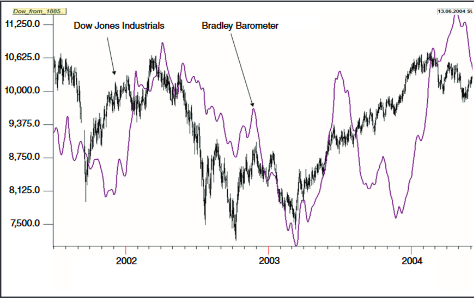
- Planetary Transits: Transiting planetary aspects that have predefined and established meanings, meticulously refined over centuries through the rigorous process of correlating observed human behavior. These predefined meanings or aspects often align with market behaviors as one would expect. By aggregating transits, we can construct mood oscillators that demonstrate a correlation with market movements. Typically, when a convergence of positive aspects occurs, the market tends to ascend. Conversely, when multiple negative aspects align, the market is often observed to decline.
- Bradley Barometer and Combined Transit Model: The Bradley Barometer, developed in 1947, employs a sophisticated system of weighted values derived from planetary transits and declination angles to forecast market trends. The comprehensive nature of the combined transit model has demonstrated remarkable precision, often pinpointing the inception and culmination of major market movements to the exact day. To further enhance the analysis of market direction, more inclusive models integrate additional celestial bodies and points, offering a more extensive perspective on potential market trajectories.
- Combined Transits: Beyond the Bradley Barometer, some astrologers use a more comprehensive set of celestial points, including asteroids and trans-Neptunian planets, aiming for a broader and more nuanced analysis of market direction.
- Efficiency Testing for Accuracy: Astrologers use efficiency testing to correlate specific transits to stock performance, aiming to make more precise predictions about market behavior.
Historical and Modern Context: Despite skepticism, financial astrology has had moments of prominence. Notably, in 1992, 1994, and 2008, a financial astrology magazine was rated among the top market forecasters on Wall Street. In the early 2000s, an astrology fund handling millions claimed that 10-15% of fund managers used their services, with demand mainly from the US and Japan. Bloomberg News even hosted a weekly show on financial astrology in 2000. These instances highlight periods when financial astrology garnered significant attention and suggested potential. However, large financial firms generally ignore financial astrology, and an analysis by Goldman Sachs found that random data produced similar results to astrological predictions, casting doubt on its reliability and accuracy.
The Use of AI and Astrological Forecasting:
The rise of AI and computerized systems in 2023 has significantly impacted various fields, including financial astrology. As technology continues to advance, it’s likely that AI and computerized systems will become even more sophisticated in their astrological analysis capabilities.
AI excels in identifying patterns and trends from large datasets. In financial astrology, AI systems can analyze historical market data alongside astrological configurations to identify potential correlations. Over time, these systems can learn from new data, refine their predictive models, and potentially provide more accurate forecasts. This will lead to more nuanced and complex models considering a wider array of astrological and astronomical factors. The integration of AI in financial astrology is poised for further growth, driven by continued interest in alternative forecasting methods and the ongoing development of AI technologies.
Benefits, Challenges, and the Way Forward: As technology advances, AI and computerized systems will become even more sophisticated in their astrological analysis capabilities. This could lead to more nuanced and complex models considering a wider array of astrological and astronomical factors. The integration of AI in financial astrology is poised for further growth, driven by continued interest in alternative forecasting methods and the ongoing development of AI technologies. Despite these advancements, the integration of AI in financial astrology still faces skepticism. Critics will argue that the lack of empirical evidence by an academic institution supporting astrology makes it an unreliable basis for AI-driven analysis. Additionally, the complexity and unpredictability of financial markets make it challenging to attribute market movements to astrological factors. Despite these challenges, AI integration with astrological financial forecasting can offer an alternative perspective that may uncover insights missed by traditional analysis.
Conclusion: The field of financial astrology represents an innovative intersection of ancient astrological principles and contemporary market analysis. It is predicated on a profound understanding of traditional astrology, including the symbolic meanings of planets and the impact of their relationships on both human behavior and market tendencies.
Engaging in the meticulous observation of planetary transits and zodiacal cycles, and assessing their potential psychological and emotional effects on market sentiment, financial astrology strives to pinpoint critical turning points in the financial markets. The study of these planetary cycles reveals patterns that may be as regular and predictable as the seasons, providing insights that could be likened to market “seasonals.”
Since the early 20th century, astrologers have noted correlations between the positioning of celestial bodies and market movements, a practice that has been significantly advanced with the aid of modern technology. This synthesis of astrological understanding with market acumen is complex, and while further research is necessary to refine its application, there are already emerging patterns that indicate the promising prognostic power of financial astrology.
This multidisciplinary approach challenges us to rethink established economic theories, considering the potential for subtle yet influential cosmic forces within the financial sphere. Financial astrology holds the promise not only of forecasting but also of deepening our comprehension of the intricate dynamics at play in the markets, weaving together threads of ancient knowledge and modern financial thought.
As financial astrology continues to develop, it stands as a compelling narrative of humanity’s long-standing enchantment with the cosmos and its possible connections to economic activities. It heralds a new era of intellectual inquiry, one that looks to the celestial sphere for fresh perspectives on the mystifying fluctuations of the financial markets.
Key Takeaways:
- Research over the past 100 years by astrologers clearly demonstrates clear patterns, indicating financial astrology has genuine potential for forecasting markets.
- Understanding the fundamentals of traditional astrology is key – the meanings of planets and how their angular relationships create themes that play out in human behavior and financial markets.
- Financial astrology aims to forecast financial markets by identifying correlations between market movements and astrological principles. It represents a fusion of cosmic wisdom and financial analysis. It is an emerging field still in the early stages of development.
- Examining planetary cycles allows us to surface repeatable, correlating patterns between planetary motions and market prices. These create market “seasonals.”
- Tracking planetary transits and zodiacal cycles and analyzing their efficiency and emotional impact on markets through barometers can reveal turning points.
- Astrologers have been witnessing financial correlations since the early 1900s, even without computers. Now, modern technology and the emergence of artificial intelligence allow more advanced forms of analysis.
- For investors and advisors open to unconventional perspectives, financial astrology holds promise as a complementary lens to decode market complexities and inform investment decisions.
- Mainstream finance may view financial astrology with profound skepticism, but interest persists in its potential to complement conventional financial analysis and provide subtler market insights.
- As astrologers continue to unravel the mysteries of the cosmos in the 21st Century, financial astrology emerges as a captivating convergence of disciplines. By harnessing the intricate patterns of the heavens, it seeks to offer profound insights into the enigmatic narratives of market trends.
Responses