
Fidelity Is Now Publicly Calling Bitcoin “Exponential Gold”

Fidelity Investments, with an impressive management of over $11 trillion in assets, stands as a paragon in the traditional financial sector. Their insights and opinions hold considerable weight, drawing global attention.
Recently, Jurrien Timmer, the Director of Global Macro at Fidelity, offered his perspective on the ascent of Bitcoin over the last three to four years. Mr. Timmer articulated that the current surge in Bitcoin’s value aligns with its historical bull markets. However, the crux of his analysis delves deeper.
He elucidated his standpoint with a chart and remarked, “In my perspective, Bitcoin operates as a commodity currency with aspirations to serve as both a hedge against monetary debasement and a store of value. I perceive it as an enhanced version of gold.”
Mr. Timmer has introduced the term “exponential gold,” offering a fitting description for Bitcoin. This digital currency encapsulates the robust monetary tenets of gold—remaining external to the system and impervious to debasement—while simultaneously harnessing the potential of emergent technological adoption.
Gold’s protective attributes combined with the growth potential of technology stocks render bitcoin as “exponential gold”—an unparalleled asset class.
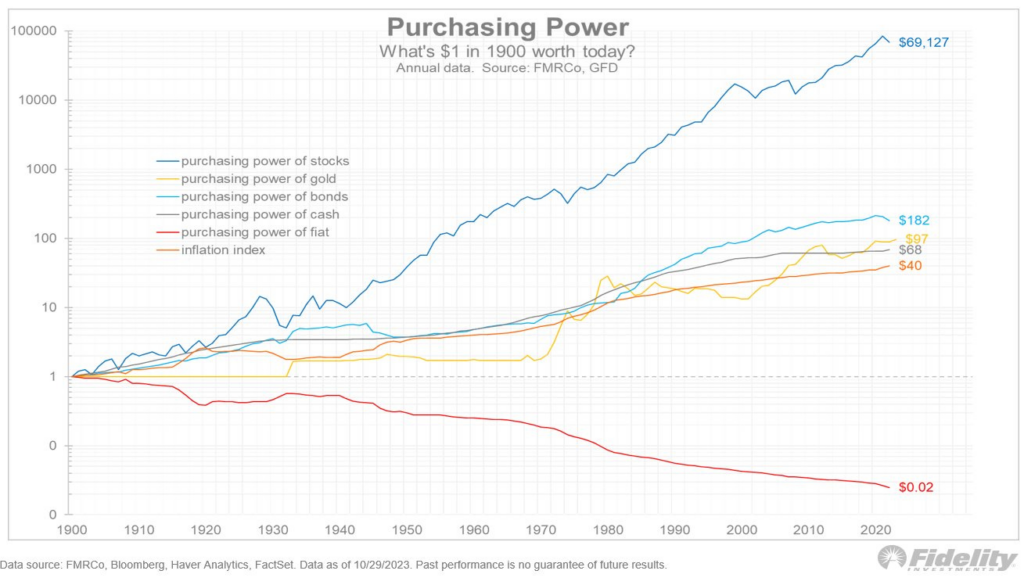
Mr. Timmer supplemented his observations with another chart demonstrating the purchasing power trends of diverse assets from the year 1900 to the present. He noted, “While gold undeniably holds monetary value, its inherent attributes render it inefficient as a medium of exchange. Consequently, it primarily serves as a store of value, drawing parallels to Bitcoin.”
He further delineated that during epochs characterized by rampant inflation, negative real rates, or excessive money supply growth, gold has historically shone, accruing market share in relation to GDP. Gold’s steadfast ability to maintain its purchasing power over time is commendable. However, its appeal seems to wane among the younger demographic, many of whom perceive it as a stagnant asset.
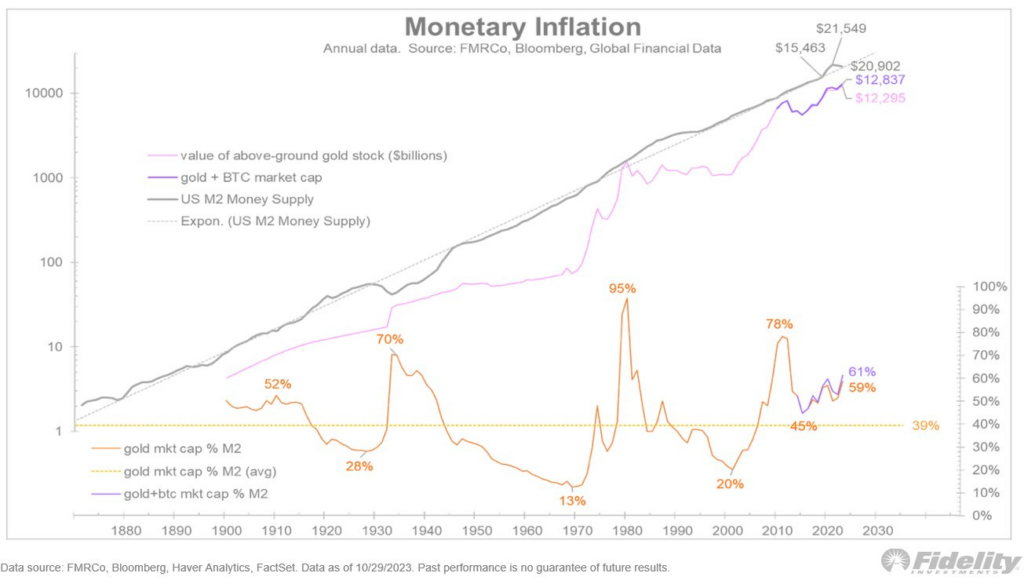
Should Bitcoin capitalize on its sound monetary principles during periods marked by high inflation or unchecked monetary policies, much like gold has historically, it stands to reason that the younger generation will increasingly gravitate towards this digital counterpart.
As noted by Balaji Srinivasan, by the year 2040, the under-30 demographic will have always known a world with Bitcoin. In their perspective, both Bitcoin and gold will be equally established.
With Fidelity Investments now recognizing bitcoin as “exponential gold,” it is conceivable that the financial giants of Wall Street are aligning with this evolving narrative. The ideal asset in a prolonged lax monetary policy environment would seamlessly blend gold’s downside protection with the upside prospects of technology stocks. Bitcoin, increasingly, seems to be fitting this mold as the embodiment of “exponential gold.”
Responses