
The Wheel of the Year and the Western Zodiac: A Tapestry of Cosmic and Earthly Cycles

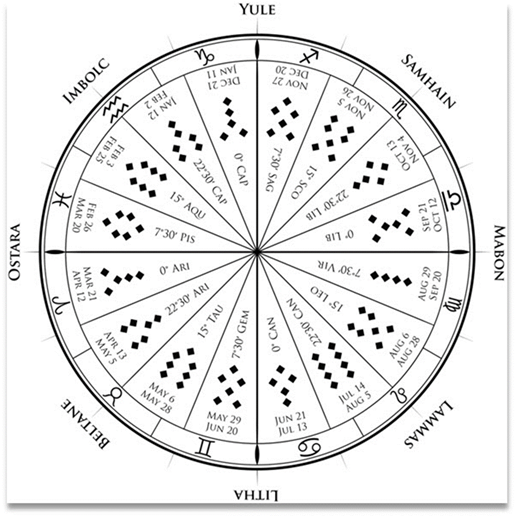
The Wheel of the Year is a celebrated framework representing seasonal shifts, revered by various branches of contemporary Paganism. This intricate wheel encapsulates major solar events like solstices and equinoxes, as well as the midpoints between these celestial occurrences. Understanding the enduring importance of seasonal cycles offers a lens into human spirituality and its connections with nature.
The Historical and Cultural Context
From Anglo-Saxon reverence for solar occurrences to the Celtic fire festivals, various ancient societies have celebrated the transition of seasons in their own unique ways. In the British Isles, the Celtic peoples observed festivals like Samhain, Imbolc, Beltane, and Lughnasa, which correspond to modern Wiccan sabbats. These festivals were deeply rooted in agrarian cycles, with rituals aimed at ensuring bountiful harvests and protection from natural calamities. Standing stones and megalithic structures like Stonehenge bear testament to these ancient practices, aligned with the solstices and equinoxes to facilitate celestial observation.
In Norse cultures, the concept of a cyclic existence was represented by Yggdrasil and the cycles of creation and destruction. While their rituals varied from those of the Celts, the foundational understanding of life as a cycle of seasons, punctuated by key transitional moments, was strikingly similar.
In a pre-industrial society without the benefit of modern calendars and the advent of contemporary timekeeping methods, the cycles embodied in the Wheel served dual roles of practical necessity and spiritual significance. Far from being merely ritualistic or symbolic, adherence to these natural cycles was an imperative guided by the essential requirements of agriculture, environmental conditions, and the collective welfare of the community. Cyclical events not only provided a framework for spiritual observance but also functioned as pragmatic calendars, dictating the optimal times for agricultural planting, ritualistic ceremonies, and preparations for seasonal weather changes.
By the time the late Middle Ages arrived, the Roman Catholic Church had taken deliberate steps to suppress these age-old practices rooted in natural cycles. However, the essential elements encapsulated by the Wheel and the various festivals associated with it proved resilient. They did not vanish completely; instead, they evolved and found new life in localized folk traditions, agricultural ceremonies, and even in Christian holidays. For instance, the essence of these ancient cycles can be detected in the Christian celebrations of Christmas and Easter, which align with the winter solstice and spring equinox, respectively.
Moreover, contemporary festivities like Halloween, which coincides with All Saints’ Day, manifest discernible influences from the Wheel’s ancient cycles. This suggests that these long-standing patterns demonstrate remarkable resilience, maintaining their presence despite significant changes in cultural and religious paradigms over time.
The Wheel of the Year in Modern Paganism and the Wiccan Tradition
In modern Paganism, particularly within Wiccan practices, these festivals are referred to as ‘sabbats,’ a term popularized by Gerald Gardner. Literature like James George Frazer’s ‘The Golden Bough’ and Margaret Murray’s ‘The Witch-Cult in Western Europe’ have further influenced modern Neopagan celebrations by delving into historical rituals and folkloric traditions.
In the Wiccan tradition, the Wheel of the Year holds a special place as a guide for ritualistic practices and spiritual growth. Originating from the synthesis of Celtic, Norse, and other ancient pagan beliefs, Wicca places a strong emphasis on the natural cycles represented by the Wheel.
Gerald Gardner, a pivotal figure in modern Wicca, played a crucial role in institutionalizing the observance of the sabbats. The sabbats serve as spiritual milestones, each corresponding to a particular aspect of the God and Goddess—central deities in Wiccan theology. For instance, Yule, the winter solstice, represents the rebirth of God and is a time for inner reflection and renewal. Ostara, the spring equinox, signifies the Goddess’s fertility and the Earth’s awakening.
The ‘Book of Shadows,’ a personalized sacred text in Wicca, often contains elaborate rituals, prayers, and correspondences related to the Wheel of the Year. These practices are not only solitary but often communal, observed in gatherings known as ‘covens’ that bring together practitioners to honor the Earth’s cycles.
Wicca also incorporates elements of the Western Zodiac into its practices, drawing on astrological insights to amplify the meaning and efficacy of its rituals. For instance, a practitioner born under the zodiac sign of Cancer may find the Moon sabbats especially resonant, given Cancer’s astrological association with the Moon.
In the Wiccan tradition, following the Wheel of the Year is not just an act of cultural preservation but a living practice that evolves and adapts to individual needs and modern understandings. It continues to serve as an essential tool for spiritual enrichment, grounding its practitioners in a cyclic view of time and existence that contrasts sharply with the linear perspective commonly held in contemporary society.
Types of Sabbats: Sun and Moon
Modern Pagan celebrations, known globally as sabbats, are divided into two categories: Sun sabbats and Moon sabbats. The Sun sabbats comprise Yule (aligned with Christmas), Ostara (Easter), Litha (Midsummer’s Eve), and Mabon (akin to Oktoberfest). These signal the beginning of each of the four seasons, coinciding with solstices and equinoxes. Conversely, the Moon sabbats, including Imbolc (St Brigid’s Day), Beltane (May Day), Lammas (Summar Harvest Festival), and Samhain (Halloween), correspond to the midpoint of each season.
The Wheel and Human Life
Beyond ritualistic observance, the Wheel of the Year serves as a philosophical framework reflecting the cycle of human life—from birth to death and, in many belief systems, rebirth. It offers a profound understanding of life’s inherent cyclical patterns, reaffirming our deep-rooted connection to nature despite technological advances.
Universality and Adaptability
Remarkably, the Wheel of the Year is a globally relevant concept. Humans across various geographical terrains have acknowledged and celebrated key points in the solar year. This emphasizes a universal, primal human urge to align with the natural world. Moreover, the integration of these ancient practices into modern religious and cultural festivities attests to the enduring adaptability of these beliefs.
Astrological Parallels: The Zodiac and the Wheel
The correlation between the Wheel of the Year and the Western Tropical Zodiac offers profound insights into the interconnectedness of astronomical phenomena, terrestrial cycles, and human spirituality. Each of the 12 zodiac signs resonates with specific energies, qualities, and themes that align with the Pagan sabbats. For instance, the pioneering spirit of Aries finds its counterpart in Ostara’s celebration of renewal, while the introspective nature of Scorpio aligns with Samhain’s focus on ancestral veneration. By examining this correlation, one can gain a deeper appreciation for the intricate tapestry of cosmic and earthly rhythms that influence our lives.
- Aries (March 21 – April 19) and Ostara (Spring Equinox)
- Aries marks the beginning of the zodiac and the astrological new year. It is associated with new beginnings, energy, and pioneering spirit. Ostara celebrated around March 20th, marks the exact moment when day and night are of equal length. As light triumphs over darkness, it heralds a period of fertility, renewal, and rebirth. Ostara rituals often involve planting seeds, both literal and metaphorical, resonating with Aries’ affinity for initiating new ventures.
- Aries marks the beginning of the zodiac and the astrological new year. It is associated with new beginnings, energy, and pioneering spirit. Ostara celebrated around March 20th, marks the exact moment when day and night are of equal length. As light triumphs over darkness, it heralds a period of fertility, renewal, and rebirth. Ostara rituals often involve planting seeds, both literal and metaphorical, resonating with Aries’ affinity for initiating new ventures.
- Taurus (April 20 – May 20) and Beltane (May 1)
- Taurus, an earth sign, resonates with themes of stability, sensuality, and material prosperity. The essence of Taurus is mirrored in Beltane, celebrated on May 1st, a festival dedicated to celebrating the abundant fertility of the Earth and the sacredness of physical union. Rituals such as the Maypole dance epitomize the harmonization of male and female energies, reflecting Taurus’ devotion to balance and material pleasure.
- Taurus, an earth sign, resonates with themes of stability, sensuality, and material prosperity. The essence of Taurus is mirrored in Beltane, celebrated on May 1st, a festival dedicated to celebrating the abundant fertility of the Earth and the sacredness of physical union. Rituals such as the Maypole dance epitomize the harmonization of male and female energies, reflecting Taurus’ devotion to balance and material pleasure.
- Gemini (May 21 – June 20) and the approach to Litha (Summer Solstice)
- Gemini is about communication, adaptability, duality, and intellectual versatility. As we approach Litha, the longest day of the year, there’s an energetic interplay between the increasing sunlight and the impending descent into the darker half of the year. Gemini’s dual nature mirrors this balance. Gemini’s dual nature aptly reflects this dichotomy, allowing for a nuanced understanding of the transition between seasons and their inherent complexities.
- Gemini is about communication, adaptability, duality, and intellectual versatility. As we approach Litha, the longest day of the year, there’s an energetic interplay between the increasing sunlight and the impending descent into the darker half of the year. Gemini’s dual nature mirrors this balance. Gemini’s dual nature aptly reflects this dichotomy, allowing for a nuanced understanding of the transition between seasons and their inherent complexities.
- Cancer (June 21 – July 22) and Litha (Summer Solstice)
- Cancer, a cardinal water sign ruled by the Moon, is deeply associated with nurturing, emotional well-being, and familial bonds. Litha, which occurs around June 21st, marks the zenith of solar power. It’s a festival that emphasizes gratitude for the abundant light while recognizing the cyclical nature of existence, including the eventual decline of that very abundance. The Cancerian focus on emotional sustenance finds a parallel in Litha’s spiritual nurturing during this high point of solar influence.
- Cancer, a cardinal water sign ruled by the Moon, is deeply associated with nurturing, emotional well-being, and familial bonds. Litha, which occurs around June 21st, marks the zenith of solar power. It’s a festival that emphasizes gratitude for the abundant light while recognizing the cyclical nature of existence, including the eventual decline of that very abundance. The Cancerian focus on emotional sustenance finds a parallel in Litha’s spiritual nurturing during this high point of solar influence.
- Leo (July 23 – August 22) and the lead-up to Lammas (August 1)
- Leo, ruled by the Sun, symbolizes self-expression, creativity, youthful vitality, and a zest for life. Leading up to Lammas, the first harvest festival, there is a recognition of the fruits of one’s labor and the celebration of achievements, aligning with Leo’s proud and vibrant energy. This first harvest festival is a time for recognizing and celebrating accomplishments, which aligns seamlessly with Leo’s inherent desire to shine and be acknowledged.
- Leo, ruled by the Sun, symbolizes self-expression, creativity, youthful vitality, and a zest for life. Leading up to Lammas, the first harvest festival, there is a recognition of the fruits of one’s labor and the celebration of achievements, aligning with Leo’s proud and vibrant energy. This first harvest festival is a time for recognizing and celebrating accomplishments, which aligns seamlessly with Leo’s inherent desire to shine and be acknowledged.
- Virgo (August 23 – September 22) and Mabon (Autumn Equinox)
- Virgo, a mutable earth sign, has an eye for detail and a natural inclination toward service and practical applications. Mabon, celebrated around September 21st, offers a moment to pause and give thanks, as well as to prepare for the leaner months ahead. Virgo’s penchant for planning and organization is especially resonant during this time of equanimity before the wheel turns toward winter.
- Libra (September 23 – October 22) and the approach to Samhain (October 31)
- Libra, ruled by Venus, is a cardinal air sign that seeks harmony, balance, fairness, and equitable relationships. As the wheel turns toward Samhain, the spiritual focus shifts to ancestry, cyclical transitions, and the permeability of the boundaries between life and death. Libra’s quest for balance offers an intellectual and emotional framework for engaging with these profound themes.
- Libra, ruled by Venus, is a cardinal air sign that seeks harmony, balance, fairness, and equitable relationships. As the wheel turns toward Samhain, the spiritual focus shifts to ancestry, cyclical transitions, and the permeability of the boundaries between life and death. Libra’s quest for balance offers an intellectual and emotional framework for engaging with these profound themes.
- Scorpio (October 23 – November 21) and Samhain (October 31)
- Scorpio, a fixed water sign ruled by Mars and Pluto, is known for its intense focus on transformation, regeneration, and probing the depths of the unconscious or unknown. Samhain, the final harvest festival, is a time for honoring the recently deceased and ancestors, and its rituals often involve divination and communication with the spirit world. Scorpio’s resonance with themes of death, followed by transformation and rebirth, makes this period especially potent for all forms of transformative work.
- Sagittarius (November 22 – December 21) and the lead-up to Yule (Winter Solstice)
- Sagittarius, a mutable fire sign ruled by Jupiter, thirsts for wisdom and broad horizons and is a sign of exploration, philosophy, and the quest for higher knowledge and truth. As the days grow shorter, there’s a natural inclination towards philosophical pondering and inner exploration to seek internal wisdom. Yule, which occurs around December 21st, is the celebration of the rebirth of the sun. Yule celebrates the return of the light, both literally and metaphorically, paralleling Sagittarius’ optimistic view of life’s cyclical nature.
- Sagittarius, a mutable fire sign ruled by Jupiter, thirsts for wisdom and broad horizons and is a sign of exploration, philosophy, and the quest for higher knowledge and truth. As the days grow shorter, there’s a natural inclination towards philosophical pondering and inner exploration to seek internal wisdom. Yule, which occurs around December 21st, is the celebration of the rebirth of the sun. Yule celebrates the return of the light, both literally and metaphorically, paralleling Sagittarius’ optimistic view of life’s cyclical nature.
- Capricorn (December 22 – January 19) and Yule (Winter Solstice)
- Capricorn, ruled by Saturn, is a cardinal earth sign that places high value on discipline, responsibility, and long-term planning. Yule, which marks the turning point where days start to lengthen again, encourages reflection and preparation for the year ahead. Capricorn’s stoicism and forward-looking perspective serve well during this festival, encapsulating hope amidst darkness.
- Capricorn, ruled by Saturn, is a cardinal earth sign that places high value on discipline, responsibility, and long-term planning. Yule, which marks the turning point where days start to lengthen again, encourages reflection and preparation for the year ahead. Capricorn’s stoicism and forward-looking perspective serve well during this festival, encapsulating hope amidst darkness.
- Aquarius (January 20 – February 18) and the period following Yule
- Aquarius, ruled by Uranus and Saturn, is a fixed air sign characterized by its progressive ideals, community focus, and innovative spirit. As the days gradually lengthen after Yule, there is a collective sigh of relief and a renewal of community bonds. The period is ripe for forward-thinking and collaborative ventures, which aligns perfectly with Aquarius’ ethos.
- Aquarius, ruled by Uranus and Saturn, is a fixed air sign characterized by its progressive ideals, community focus, and innovative spirit. As the days gradually lengthen after Yule, there is a collective sigh of relief and a renewal of community bonds. The period is ripe for forward-thinking and collaborative ventures, which aligns perfectly with Aquarius’ ethos.
- Pisces (February 19 – March 20) and the lead-up to Ostara (Spring Equinox)
- Pisces, a mutable water sign ruled by Jupiter and Neptune, possesses an innate sensitivity to the intangible realms of dreams, intuition, and spirituality. The period leading up to Ostara is one of transitional energy, moving from the introspective focus of winter toward the potential for rebirth in spring. Pisces’ ability to navigate both the material and immaterial worlds offers a spiritually enriching perspective as Ostara approaches.
In essence, the Wheel of the Year and the Western Tropical Zodiac are deeply intertwined, with each zodiac sign reflecting specific energies, qualities, and themes that correspond with the sabbats and esbats of the pagan calendar. Understanding this correlation provides a richer appreciation of the cyclical nature of life and the cosmic patterns that influence earthly and human experiences.
A Cosmic and Earthly Dance
The Wheel of the Year serves not merely as a series of Pagan festivals but as a rich tapestry that weaves together human spirituality, cosmic occurrences, and the cycles of the Earth. In contemporary life, following the Wheel of the Year can offer a structured framework for personal growth, self-reflection, and a more nuanced understanding of temporal cycles. The Wheel of the Year, predominantly celebrated within Pagan and Wiccan communities, serves as an alignment mechanism between individuals and Earth’s seasonal flux. This alignment fosters ecological harmony, grounding the individual in the spiritual significance of each season’s transition. Observance of key festivals, such as Samhain, Yule, or Ostara, becomes not merely ritualistic but transformative, engendering a state of spiritual equilibrium and emotional well-being.
On the other hand, the Western Zodiac, rooted in the Western astrological tradition, provides insights into individual temperament, personality traits, latent strengths, and challenges. By following the astrological calendar and its planetary transits, people can make informed decisions in various aspects of life, be it relationships, careers, or personal development. Together, these two systems provide a comprehensive toolkit of symbols, rites, and philosophical constructs that facilitate a deeper connection with oneself, the wider community, and the environment. By conscientiously integrating these time-honored frameworks into the fabric of contemporary life, individuals stand to gain a more harmonious and insightful pathway through the labyrinthine complexities and volatilities that typify our post-modern era.
As we find ourselves in an age increasingly disconnected from the natural world, revisiting these ancient cycles offers not just a spiritual anchor but also a holistic perspective on life. Understanding the nuanced interplay between the Wheel and the Western Zodiac enriches our appreciation of the universe’s complex rhythms—rhythms that guide not just the seasons but also the unfolding tapestry of human existence.
Responses