
Project A119: In 1958 The U.S. Military Planned to Nuke the Moon

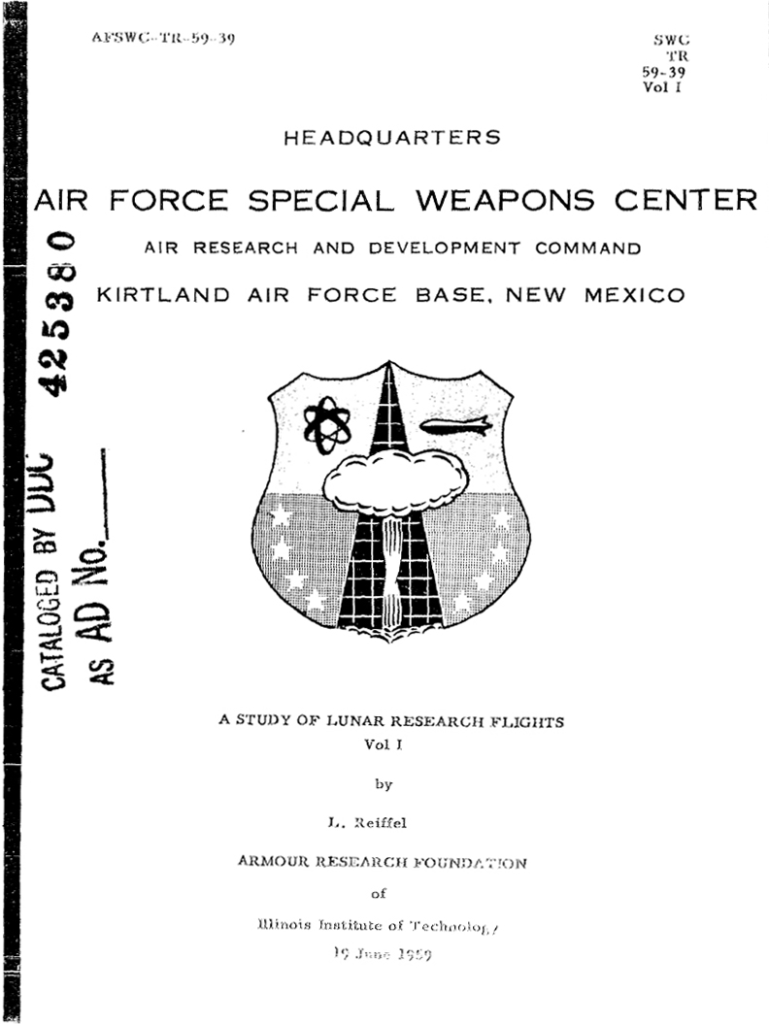
Project A119, also known as A Study of Lunar Research Flights, was a top-secret plan developed in 1958 by the United States Air Force. The aim of the project was to detonate a nuclear bomb on the Moon, which would help in answering some of the mysteries in planetary astronomy and astrogeology. If the explosive device detonated on the surface, and not in a lunar crater, the flash of explosive light would have been faintly visible to people on Earth with their naked eyes. This was meant as a show of force resulting in a possible boosting of domestic morale in the capabilities of the United States, a boost that was needed after the Soviet Union took an early lead in the Space Race and was also working on a similar project.
During the Cold War (1947 – 1991), the Soviet Union took the lead in the Space Race with the launch of Sputnik 1 on October 4th, 1957. Sputnik was the first artificial satellite in orbit around the Earth, and the surprise of its successful launch, compounded by the resounding failure of Project Vanguard to launch an American satellite after two attempts, had been dubbed the “Sputnik crisis” by the media and was the impetus for the beginning of the Space Race. Trying to reclaim lost ground, the United States embarked on a series of new projects and studies, which eventually included the launch of Explorer 1, the creation of the Defense Advanced Research Projects Agency (DARPA), and NASA.
At the time of the project’s conception, newspapers were reporting a rumor that the Soviet Union was planning to detonate a hydrogen bomb on the Moon. According to press reports in late 1957, an anonymous source had divulged to a United States Secret Service agent that the Soviets planned to commemorate the anniversary of the October Revolution by causing a nuclear explosion on the Moon to coincide with a lunar eclipse on November 7th, 1957. News reports of the rumored launch included mention of targeting the dark side of the terminator—Project A119 would also consider this boundary as the target for an explosion. It was also reported that a failure to hit the Moon would likely result in the missile returning to Earth.

The existence of the US project was revealed in 2000 by a former executive at the National Aeronautics and Space Administration (NASA), Leonard Reiffel, who had led the project in 1958. A young Carl Sagan was part of the team responsible for predicting the effects of a nuclear explosion in a vacuum and low gravity and in evaluating the scientific value of the project. The project documents remained secret for nearly 45 years, and despite Reiffel’s revelations, the United States government has never officially recognized its involvement in the study.
This video talks about both the US and USSR projects and plans which wanted to detonate a nuclear bomb on the surface of the moon. How and why did that even happen? Watch the video to find out.
Responses