
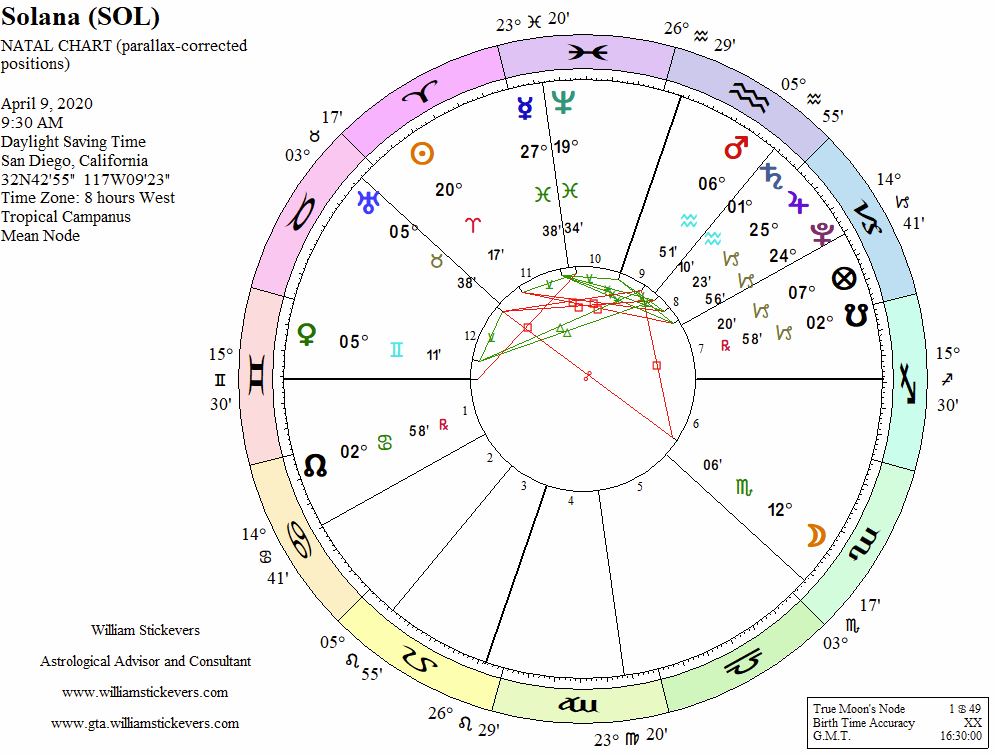
Solana (SOL)

The future of how money will be used and distributed is becoming ever clearer as we begin to see the continued growth and adoption of decentralized finance, or DeFi, as it’s more popularly known. However, we are also beginning to unravel more of the limitations around major blockchains, such as Ethereum, that power the many applications and platforms that offer DeFi services through issues such as poor scalability, lengthy confirmation times, and high transaction fees.
This, then, is where Solana comes in to not only solve these obstacles but offers more in return with the ability to extract greater potential from decentralization. Solana is a high-throughput, single-layer blockchain with breakthrough innovations that focuses on building greatly scalable blockchain infrastructures without sacrificing network security or the principles of decentralization.
In return, this helps to support more growth-centric and high-frequency applications that would normally cripple other blockchains while also retaining both a trust-less and permission-less distributed protocol.
8 Innovations that Make Solana the First Web-Scale Blockchain
Since its inception, the Solana team — comprised of pioneering technologists from Qualcomm, Intel, Netscape, and Google—has focused on building the tech required for Solana to function with these groundbreaking performance standards.
In order to create a decentralized, permissionless network that matches the performance of a single node, the Solana team developed 8 key technologies:
- Proof of History (POH) — a clock before consensus;
- Tower BFT — a PoH-optimized version of PBFT;
- Turbine — a block propagation protocol;
- Gulf Stream — Mempool-less transaction forwarding protocol;
- Sealevel — Parallel smart contracts run-time;
- Pipelining — a Transaction Processing Unit for validation optimization
- Cloudbreak — Horizontally-Scaled Accounts Database; and
- Archivers — Distributed ledger storage
As a result of these 8 major innovations, the Solana network is a lightning-fast distributed ledger technology that will always keep going. It is not slowed down by consensus. Moreover, the system optimizes data propagation, leverages parallel GPUs massively for transaction processing, and does not weigh down validators with massive stored chain history.
Solana’s software is designed to get out of the way and let the hardware operate at capacity. As such, Solana scales naturally with bandwidth, SSDs, and GPU cores. It is the only blockchain that does, and is how Solana achieves 50,000 TPS on a network of 200 physically distinct nodes around the world.
– TIMESTAMPS –
0:00 Intro
1:55 Solana Recap
4:14 SOL Updated Tokenomics
7:08 Solana Updates
9:52 SOL Price Analysis
12:31 Solana Ecosystem
15:14 Conclusion
Responses