
Why Trump Should Win the 2020 Election Lawsuit In Pennsylvania

by Byron York, Chief Political Correspondent
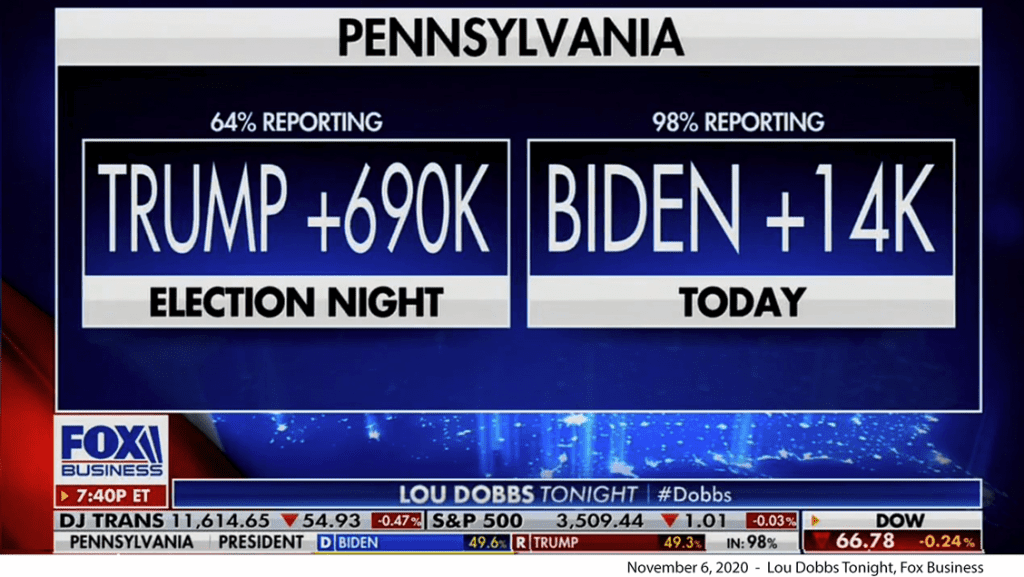
The first thing to remember is that the Constitution gives state legislatures the authority to make rules governing the conduct of elections for federal offices in their state. In October 2019, the Pennsylvania state legislature passed Act 77, which updated and revised the rules for elections in the state.
For the first time ever, it allowed all Pennsylvanians to vote by mail if they chose, without requiring that they show they would be absent from their voting district on election day. On the question of voting by mail, the legislature made one clear, unambiguous requirement: All mail-in ballots had to be received by 8 p.m. on election day. Then on September 17th the Pennsylvania State Supreme Court, which had a 5 to 2 Democratic majority. threw out the legislature’s deadline for ballots and created a new one: 5 p.m. on November 6, three days after election day.
The matter went to the U.S. Supreme Court, which split 4 to 4 on whether it should intervene. (New Justice Amy Coney Barrett was not up on the case.) That meant the Court took no action. Pennsylvania would keep accepting ballots for three days after election day. Justice Samuel Alito protested vigorously. “The Court’s handling of the important constitutional issue raised by this matter has needlessly created conditions that could lead to serious post-election problems,” he wrote. But Alito’s words went unheeded, and the election went on with the state supreme court’s new ballot deadline.
The results in Pennsylvania, of course, are very close — it took days to call the race for Joe Biden — and the court-created deadline is part of a confusing and difficult situation. Along with Justices Thomas and Gorsuch, Alito concluded that the Pennsylvania case “has national importance, and there is a strong likelihood that the state supreme court decision violates the federal Constitution.”
On Monday, ten states — Missouri, Alabama, Arkansas, Florida, Kentucky, Louisiana, Mississippi, South Carolina, South Dakota, and Texas — filed an amicus brief upholding the importance of the constitutional rights of state legislatures. “The Pennsylvania supreme court’s decision overstepped its constitutional responsibility, encroached on the authority of the Pennsylvania legislature, and violated the plain language of the [Constitution’s] Election Clauses.”
It appears Republicans have a strong case that the Pennsylvania court exceeded its authority. John Yoo, Berkeley professor, and former George W. Bush Justice Department official, offers in his words what might happen:
“President Trump’s campaign can challenge the vote on the ground that the Pennsylvania Supreme Court unconstitutionally interfered with the state legislature’s sole authority over the time, place, and manner of federal elections and over the selection of presidential electors. If the federal Constitution directly grants those powers to the legislature of Pennsylvania, state courts have no authority to alter state election law for federal office, including the presidency. The Supreme Court could strike down the extension of the Pennsylvania deadline to Nov. 6 and order the state to reject any ballots that arrived after [8 pm on] election day. This is not some constitutional flight of fancy. Justice Samuel Alito has already made clear his view that the Pennsylvania Supreme Court has violated the Constitution…He wrote: “The Supreme Court of Pennsylvania has issued a decree that squarely alters an important statutory provision enacted by the Pennsylvania Legislature pursuant to its authority under the Constitution of the United States to make rules governing the conduct of elections for federal office.”
Very good article, thanks William
Thanks, Nick!