
Kardashev Scale: Type 0 – 7 Civilizations

The Kardashev Scale
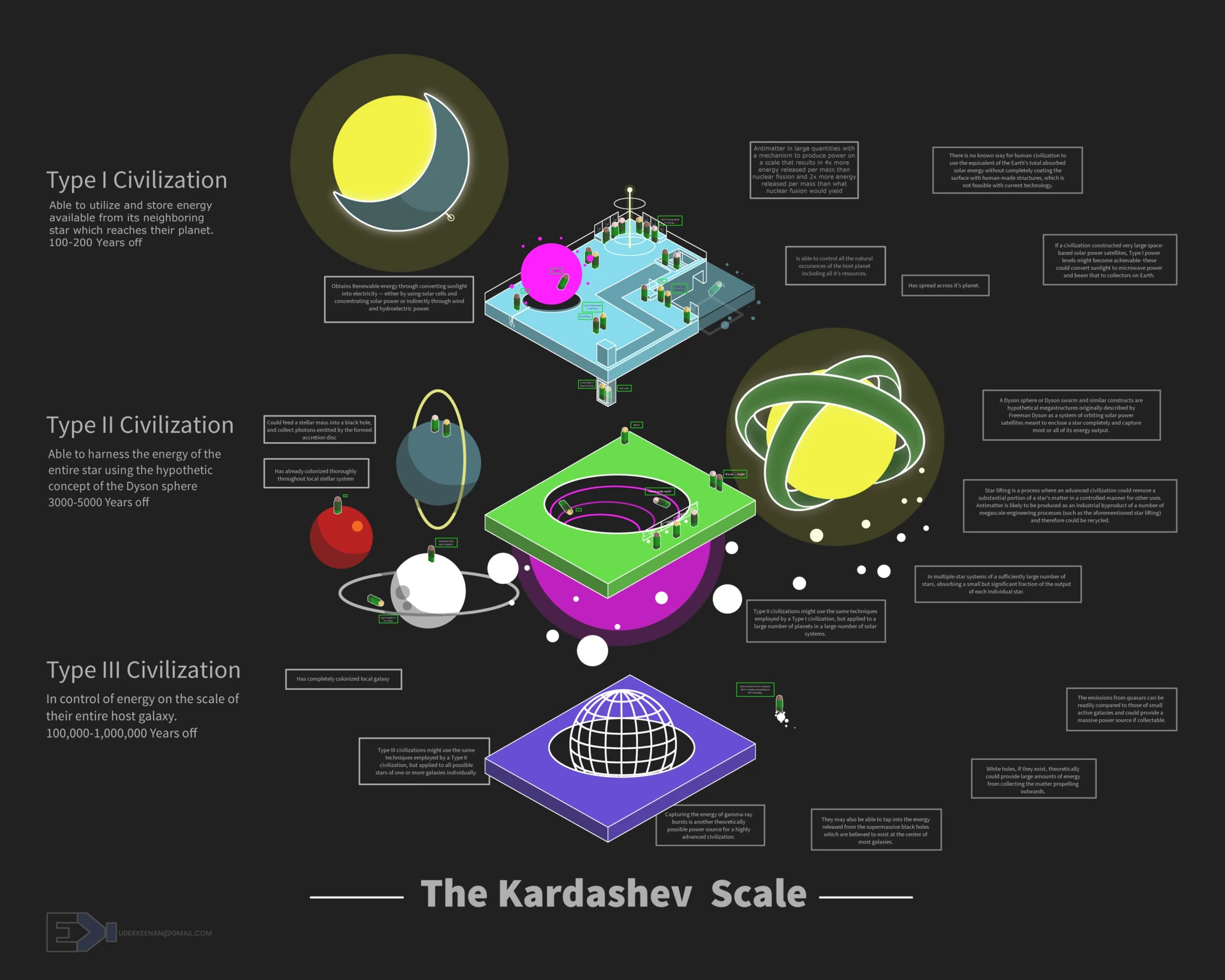
The Kardashev Scale is a measurement created by Russian astrophysicist Nikolai Kardashev, meant to measure the scale of a civilization’s technological advancement, measured through its energy output. In theory, this could allow astronomers to predict the advancement of an alien civilization the same way as observing the luminosity of stars.
The Kardashev scale is also a method of classifying how technologically advanced a civilization is. It has several categories, based on the amount of usable energy a civilization has at its disposal and increasing logarithmically.
Astrophysicist Carl Sagan suggested a mathematical formula for defining intermediates:
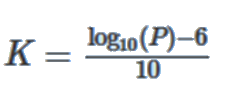
Where K is the civilization’s development on the Kardashev Scale and P is the civilization’s entire available power in Watts. For instance, in 2008, the world’s average power consumption was 16 terawatts (1.6 x 1E13 W), with Sagan’s formula that equals (log(1.6*10^(13-6)))/10 = 0.72

Type 0 Civilization
Type 0 – A pre-planetary civilization extracts its energy, information, raw-materials from crude organic-based sources, and fossil fuel sources from its home planet, but not to its full potential. The primary focus is local and tribal warfare, local in culture, mono-cultural and theistic, global-scale influence.
125,000 BCE: Type 0.10 – Controlled Use of Fire.
3,000 BCE: Type 0.20 – Agrarian Revolution
1000 BCE: Type 0.30 – Rise of Roman Civilization
1700 A.D.: Type 0.35 – First Industrial Revolution
1900 A.D.: Type 0.40 – Second Industrial Revolution
1950 A.D.: Type 0.50 – Third Industrial Revolution
1960 A.D.: Type 0.60 – Nuclear Power Revolution
1970 A.D.: Type 0.65 – The Microprocessor Revolution
1980 A.D.: Type 0.70 – The Personal Computer Revolution
1990 A.D.: Type 0.71 – The Digital Revolution
2000 A.D.: Type 0.72 – Internet Revolution
2010: A.D: Type 0.73 – Fourth Industrial Revolution
2020 A.D.: Type 0.74 – Solar Power Revolution
2030 A.D. : Type 0.75 – Nuclear Fusion Revolution
2040 A.D.: Type 0.76 – Fifth Industrial Revolution: Nano Technology
2050 A.D.: Type 0.77 – Technological Singularity
2060 A.D.: Type 0.78 – Medical Singularity
2070 A.D.: Type 0.79 – Sixth Industrial Revolution: Space-Based Industry
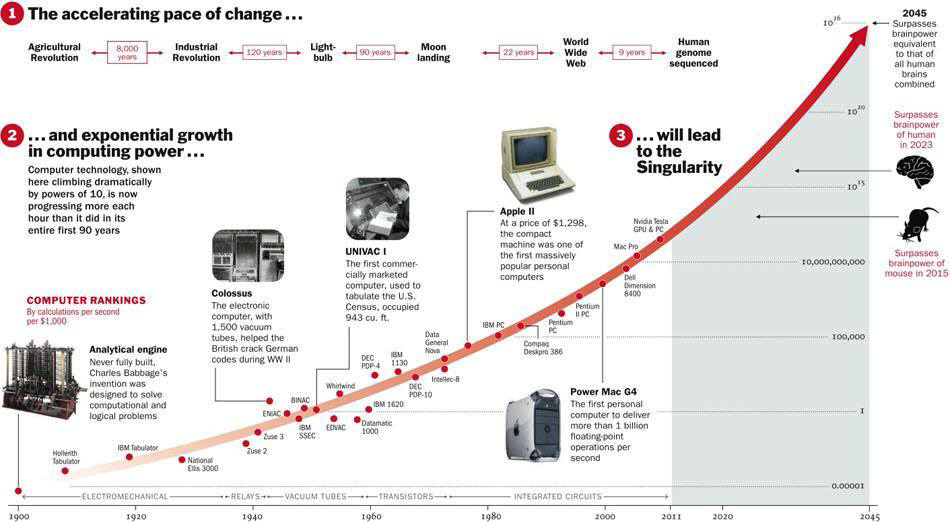
But where is all this technological change leading? Where is the final destination in this long voyage into science and technology?
The culmination of all these upheavals is the formation of planetary civilization, what physicists call a Type I Civilization. This transition is perhaps the greatest transition in history, marking a sharp departure from all civilizations of the past.Every headline that dominates the news reflects, in some way, the birth pangs of the planetary civilization. Commerce, trade, culture, language, entertainment, leisure activities, and even war are all being revolutionized by the emergence of this planetary civilization.
— Michio Kaku, Physics of the Future
Type I Civilization
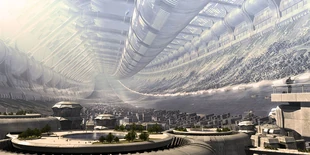
Type I – A planetary civilization that is able to harness all of the power available on a single planet, approximately 1016 W. A Type I civilization has a large-scale application of nuclear fusion power throughout the planet, capable of controlling the weather, influence global flora, and fauna, geological makeup, plate tectonics, etc. Capable of orbital spaceflight and planetary colonization of the Solar System. Capable of manipulating objects over the scale of themselves: building structures, mining, joining and breaking solids; has achieved medical and technological singularity, planetary engineering, trade and defense, and stellar system-scale influence. Examples of a Type I Civilization in fiction are:
- Buck Rogers
- Flash Gordon
- Space: 1999
- Ego (Marvel Comics)
Type II Civilization
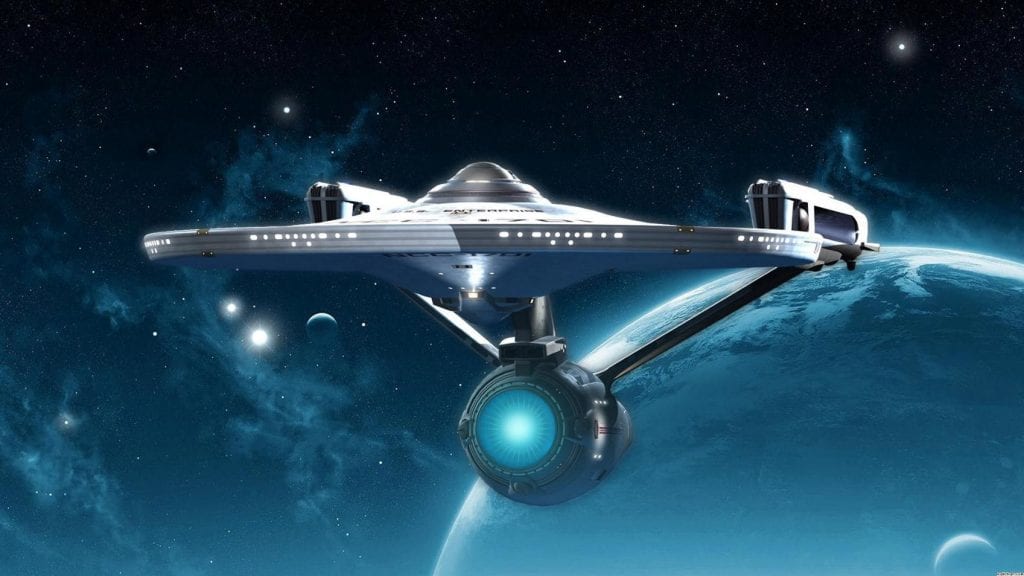
Type II – A stellar civilization that is able to harness all of the power available from a single star, approximately 1026 W. Type II civilizations might use the same techniques employed by a Type I civilization, but applied to a large number of planets in a large number of planetary systems. A Type II civilization is capable of interplanetary spaceflight, interplanetary communication, stellar engineering, and star cluster-scale influence. Examples of a Type II Civilization in fiction are:
- The United Federation of Planets (Star Trek)
- Prelude to Foundation (Issac Asimov)
- The Imperium of Man (Warhammer 40,000) (Borderline Type II)
Type III Civilization
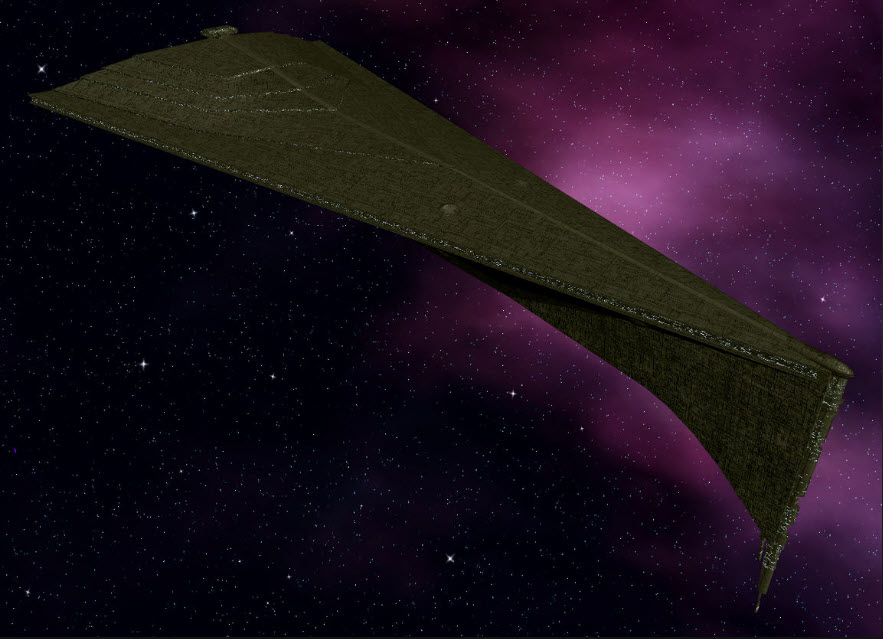
Type III – A galactic civilization that is able to harness all of the power available from a single galaxy, approximately 1036 W. A type III civilizations might use the same techniques employed by a Type II civilization but applied to all possible stars of one or more galaxies individually. A Type III civilization is capable of manipulating molecules and molecular bonds, creating new materials capable of interstellar travel, interstellar communication, galactic engineering, and galaxy-scale influence.
- DAoT Humanity, Pre-Fall Aeldari, the T’au Empire and The Necrons (Warhammer 40,000)
- The Old Republic (Star Wars)
- Humanity (Blame!)
Type IV Civilization
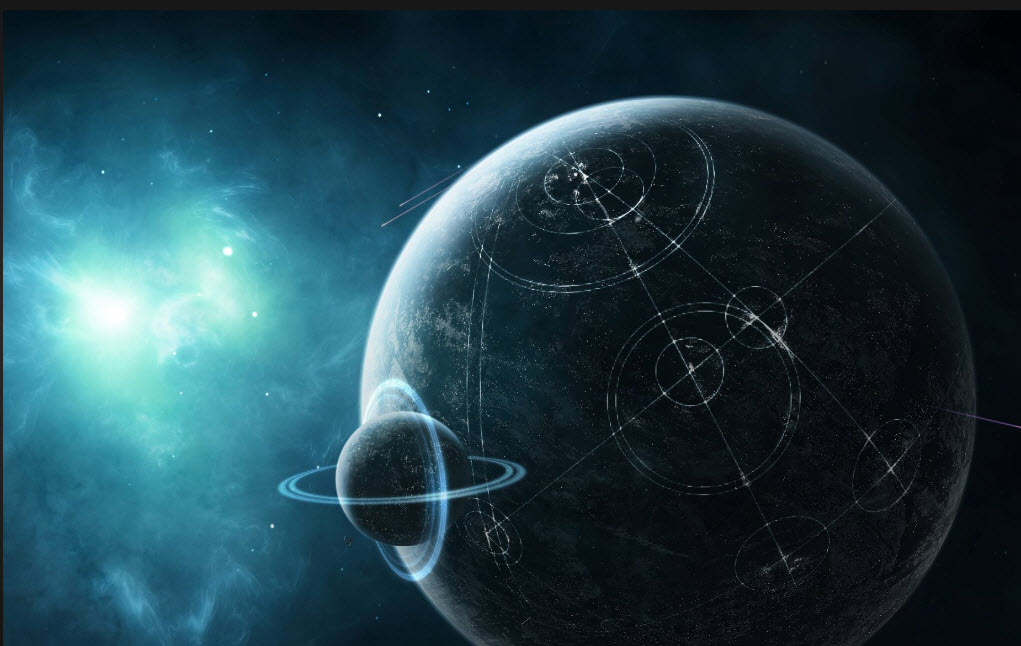
Type IV – A universal civilization that controls the energy output of a galactic supercluster; approximately 1046W. A Type IV civilization is capable of manipulating individual atoms, creating nanotechnologies on the atomic scale, able to harness “extragalactic” energy sources such as dark matter, and creating complex forms of artificial life. Capable of intergalactic travel, intergalactic communication, and universal-scale influence. Examples of a Type IV Civilization in fiction are:
- The Celestials from Star Wars
- Watchers (Marvel Comics)
- Ascended Ancients from Stargate
- Omega Point of Frank Tipler

Type V Civilization
Type V – A multiversal civilization that has control over the entire universe; approximately 1056W. A Type V civilization is capable of manipulating the atomic nucleus and engineering the nucleons that compose it; capable of universe-scale manipulation of individual discrete universes from an external frame of reference, able to harness “extragalactic” energy sources such as dark energy. Cable to create galaxy-sized ships traveling through time and other universes. Examples of a Type V Civilization in fiction are:
- Asgard (Thor in Marvel Comics)
- Marble Aliens (Men in Black)
- Mazoku / Shinzoku (Slayers)

Type VI Civilization
Type VI – A megaversal civilization that has control over the entire universe; approximately 3.9 x 1E69 watts and above. A Type VI Civilization is capable of manipulating the most elementary particles of matter (quarks and leptons) to create organized complexity among populations of elementary particles; has control and draws energy over multiple universes with a power level that is technically infinite. Able to use time travel to induce the creation of a universe.
- The Celestials (Marvel Comics)
- The Q (Star Trek The Next Generation)

Type VII Civilization
Type VII – A omiversal civilization is capable of manipulating the basic structure of space and time; able to create an eminent domain for the purpose of creating a multiverse at will, using them as an energy source, a power level that is beyond infinite.
- The Time Lords and the Daleks (Doctor Who)
- Monitors (DC Comic)
- The Beyonders (Marvel Comics)
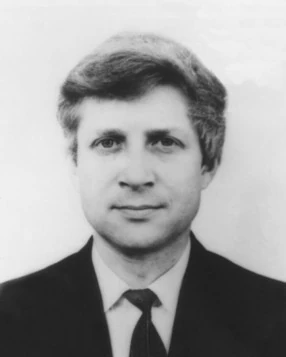
He passed away on August 3, 2019, in Moscow at the age of 87.
Responses